
 Italiano
 简体中文
 Deutsch
 English
 Français
 Español
 Nederlands
 Svenska
 日本語
 Polski
 Português
 Русский
 Ελληνικά
 العربية
 Türkçe
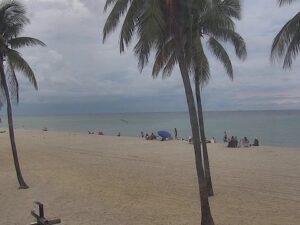
Live
Spiaggia di Hollywood, Florida
Hollywood Beach, Hollywood, Florida, Stati Uniti
 29.4°C / 84.9°F
 14:5014:50:33
 30.1°C / 86.2°F
 Nubi sparse
 63%
 13 km/h / 8 mph
 06:41
 17:34
Caricamento delle previsioni…
Hollywood Beach, Hollywood, Florida, Stati Uniti
29.4°C / 84.9°F
14:50
New River South Fork, Fort Lauderdale, Florida, Stati Uniti
 29.4°C / 84.9°F
14:50


Green Parrot Bar, Whitehead Street, Key West, Florida, USA
27.9°C / 82.2°F
14:50

Pompano Beach, Hillsboro Inlet, Florida, Stati Uniti
29.4°C / 84.9°F
14:50


Jewfish Creek, Key Largo, Florida, USA
28.9°C / 84°F
14:50
Fort Myers Beach, Estero Island, Florida, Stati Uniti
29.8°C / 85.6°F
14:50

Moore Haven, Lago Okeechobee, Florida, Stati Uniti
29.5°C / 85.1°F
14:50The Ormond-by-the-Sea Webcam is a 180-degree beach camera run by Volusia County, looking out over the Atlantic Ocean from the beachfront of Ormond-by-the-Sea on Florida’s northeast coast. The wide lens bends the shoreline into a long curve, so a single picture holds the dry sand below the camera, the darker band of wet sand at the water’s edge, several lines of breaking waves and open sea running up to the horizon. At the far left, a railed walkway crosses the dune beside green dune plants, and at the far right sits the corner of a white beachfront structure with railings. Footprints and tire tracks cross the sand, and the pattern of foam in the surf changes from one minute to the next. On autumn mornings the low sun lays a bright patch of glare on the water on the right side of the picture, and a small weather badge in the top corner shows the current temperature.
Ormond-by-the-Sea is an unincorporated community and census-designated place in Volusia County, on the narrow strip of land between the Atlantic Ocean to the east and the Halifax River to the west. The city of Ormond Beach borders it to the south, and the Flagler County line marks its northern edge. It covers about 5.2 square kilometers (2.0 square miles), sits about 4 meters (13 feet) above sea level and had 7,312 residents at the 2020 census. State Road A1A runs through it as Ocean Shore Boulevard, close to the beach, while John Anderson Drive follows the river side. The center of Daytona Beach is about 15 kilometers (9.5 miles) to the south in a straight line, and Flagler Beach is a similar distance to the north.
The Ormond-by-the-Sea Webcam is one of the beach cameras streamed by Volusia County Beaches, the county’s beach channel, which links to Volusia County’s Beach Safety pages. The county’s beach cam page lists Ormond-by-the-Sea as its north beach camera and describes it as mounted on a lifeguard tower in the north of the community. The same channel streams 180-degree cameras at Ormond Beach, Dunlawton, Ponce Inlet and New Smyrna Beach, so the surf can be compared along much of the county’s coast.
This shoreline has a little history of its own. The Ormond Pier, a 230-meter (750-foot) steel pier built in 1959, once reached into the ocean from Ormond-by-the-Sea. Storm damage in 1984 and later demolition meant it was gone by the early 1990s. Near A1A and Spanish Waters Drive stands a World War II watch tower, built for the Coast Guard Reserve in 1942 and restored in 2004.
Winters on this stretch of coast are mild. Ten-year averages for 2016 to 2025 put January highs at about 19°C (66°F) and lows near 12°C (53°F) right at the shore, and December to March is the driest part of the year, with roughly 57 to 64 millimeters (2.2 to 2.5 inches) of rain a month. Spring warms quickly: April afternoons average about 25°C (78°F) and May about 28°C (83°F).
Summer is hot and wet. July highs average about 31°C (88°F) with nights around 24°C (76°F), and most of the rain falls from June to October, peaking in September at about 210 millimeters (8.3 inches). The Atlantic hurricane season runs from June 1 to November 30, so late summer and early autumn are when big swells and storm surf are most likely to reach the camera. October cools to highs near 27°C (80°F) and November to about 23°C (74°F). Sea turtles nest on this coast, and local beach guidance warns that disturbing a turtle or its nest is a third-degree felony.
Ocean Shore Boulevard is lined with small public beach accesses, most of them plain dune walkovers at the end of a residential street, plus a few larger parks. Tom Renick Park, in the 1500 block and named for a former Volusia County Beach Safety director, has an accessible dune walkover, restrooms, a picnic area, a lifeguard tower and a parking lot. Al Weeks Sr. North Shore Park at 1631 Ocean Shore Boulevard and Bicentennial Park in the 1800 block add more walkovers, restrooms, picnic areas and parking. At the northern end of the community, North Peninsula State Park protects about 3.2 square kilometers (800 acres) of coastal dunes and marshland.
A1A through Ormond-by-the-Sea is also the eastern leg of the Ormond Scenic Loop and Trail, a Florida Scenic Highway whose central leg follows John Anderson Drive along the Halifax River and which takes in Tomoka State Park. Sources put the full loop at 48 to 58 kilometers (30 to 36 miles), depending on the route. To the south in Ormond Beach, The Casements, the former winter home of John D. Rockefeller on the Halifax River, is now a cultural center that is open for tours.
More Atlantic beaches and coastal sights from Florida and the Carolinas:
Ormond-by-the-Sea is in Volusia County on Florida’s northeast Atlantic coast, on the strip of land between the ocean and the Halifax River. Ormond Beach lies directly to the south and the Flagler County line to the north, and the center of Daytona Beach is about 15 kilometers (9.5 miles) away.
A 180-degree panorama of the beach: sand and footprints in the foreground, the surf zone with its lines of breaking waves, and the Atlantic out to the horizon. A railed dune walkover edges the left side of the picture and a white beachfront structure the right.
Volusia County streams it on its Volusia County Beaches YouTube channel, which links to the county’s Beach Safety pages. The county lists it as its north beach camera.
The camera takes in a 180-degree view, and fitting half a circle into one flat, wide picture bends the straight shoreline and the horizon into arcs. On the ground the beach runs in a fairly straight line.
Mild winters and hot, wet summers. January averages highs of about 19°C (66°F) at the shore, July about 31°C (88°F), and September is the wettest month with roughly 210 millimeters (8.3 inches) of rain.
No. The Ormond Pier, a 230-meter (750-foot) steel pier built in 1959, was damaged by a storm in 1984 and later demolished, and it was gone by the early 1990s.
The Atlantic hurricane season runs from June 1 to November 30. Storms that stay well out to sea can still send long swells onto this beach.
Yes. The same channel streams 180-degree cameras at Ormond Beach, Dunlawton, Ponce Inlet and New Smyrna Beach, all farther south along the county’s coast.
Source: Volusia County Beaches
Le migliori nuove webcam in diretta e le funzionalità del sito, una volta a settimana.
Iscrivendoti, accetti di ricevere la nostra email settimanale. Puoi disiscriverti in qualsiasi momento.