
 Italiano
 简体中文
 Deutsch
 English
 Français
 Español
 Nederlands
 Svenska
 日本語
 Polski
 Português
 Русский
 Ελληνικά
 العربية
 Türkçe
Live
 11:27:48
 16.8°C / 62.2°F
 Nubi sparse
 78%
 8 km/h / 5 mph
 06:31
 16:43
Caricamento delle previsioni…


Hounsfield, Contea di Jefferson, New York, Stati Uniti
 7.9°C / 46.2°F
11:27

Tiana Beach, Hampton Bays, New York, Stati Uniti
 16.2°C / 61.2°F
11:27


Teugega Country Club, Golf Course Road, Rome, New York, USA
6.7°C / 44.1°F
11:27
Cascate Americane, Cascate del Niagara, New York, USA
8.7°C / 47.7°F
11:27
Peace Bridge, fiume Niagara, Buffalo, New York, Stati Uniti
9.6°C / 49.3°F
11:27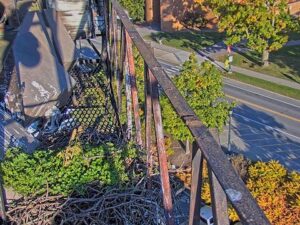


The Oyster Bay Osprey Webcam looks down on a large stick nest that PSEG Long Island keeps on a safe platform beside Mill Neck Creek in Bayville, in the Town of Oyster Bay on Long Island’s North Shore. The nest fills the foreground, a broad mound of branches scattered with pale shells, with a weathered wooden T-shaped perch on its left. Behind it a long black floating breakwater curves across the water, and dozens of sailboats ride at their moorings in front of a wooded far shore lined with houses. PSEG Long Island gives the birds’ season here as March 15 to October 19, when a pair can be watched rebuilding the nest, laying eggs and raising chicks. Outside those months the platform stands empty, and the picture belongs to the tide, the boats and the color of the trees on the far shore.
The platform stands beside the dock of Frank M. Flower and Sons, a shellfish company whose sign shows at the bottom right of the picture. New York’s Department of State traces the firm to 1887 at Shu Swamp in Mill Neck and places its present site, occupied since 1940, on Mill Neck Creek west of the Bayville Bridge. The creek is a narrow coastal bay that empties into the western side of Oyster Bay Harbor. The bridge, a 165-meter (541-foot) drawbridge opened in 1938, is the fourth on that crossing since the first span of 1898, and it sits about 1.2 kilometers (0.7 miles) east of the nest.
Ospreys often build on utility poles, where a wingspan can complete a circuit between energized equipment, so PSEG Long Island moves nests to purpose-built platforms. The utility says it has relocated more than two dozen nests and made eight more safe in place. This camera went live in March 2020 on a nest its lineworkers had relocated, alongside a second camera in Patchogue that has since been retired. The camera uses infrared at night, so no light shines on the birds.
Mill Neck Creek and most of Oyster Bay Harbor lie within the Congressman Lester Wolff Oyster Bay National Wildlife Refuge, more than 1,200 hectares (3,000 acres) of submerged land and tidal marsh. The state’s coastal plan for Bayville lists the neighboring Oak Neck Creek marsh as a nursery for menhaden, bluefish and winter flounder, and notes ospreys feeding there.
Winters on this part of the North Shore are cold without being severe. Ten years of reanalysis data for the creek (2015 to 2024) give January afternoons of about 4°C (39°F) and nights near -3°C (27°F), close to the 1991 to 2020 normals for Mineola, farther inland. Spring comes slowly off the water: when the ospreys are due back in mid-March, afternoons reach only about 9°C (48°F), rising to 15°C (59°F) in April and 20°C (68°F) in May, as the trees on the far shore leaf out.
Summer is warm while the chicks grow, with July afternoons around 29°C (84°F) and nights of 19°C to 21°C (66°F to 70°F). September still averages about 24°C (75°F), falling to 18°C (64°F) in October as the woods on the far shore turn brown and gold. By then the ospreys have gone; North American breeders winter in South America, though some stay in the southernmost United States, a journey of the kind traced on our bird migration map. Precipitation is spread evenly through the year, about 1,250 millimeters (49 inches) in all, with most months between 80 and 120 millimeters (3.1 and 4.7 inches).
In Bayville itself, Charles E. Ransom Beach is a Town of Oyster Bay beach on Long Island Sound about 1.6 kilometers (1 mile) west of the nest, with Stehli Beach just past the village line and Centre Island Beach to the east, where the sand faces both the Sound and the harbor. The village’s Harrison Williams Woods has walking paths. The refuge is reached by water, with small boats launching from Creek Beach or West Harbor Beach, and its waterfowl peak from October through April, when more than 20,000 ducks have been counted in a single survey.
Across the harbor on Cove Neck, Sagamore Hill National Historic Site preserves the house where Theodore Roosevelt lived from 1885 until his death in 1919, with the Theodore Roosevelt Museum on the grounds. Roosevelt is considered the founder of the National Wildlife Refuge System, and the refuge’s waters surround his old estate. Inland in Upper Brookville, Planting Fields Arboretum State Historic Park covers more than 160 hectares (400 acres) of gardens, greenhouses and woodland paths around the 67-room Main House, formerly known as Coe Hall.
More nests and New York cams to watch next:
In the Village of Bayville, Town of Oyster Bay, Nassau County, on Long Island’s North Shore. It stands beside a shellfish dock on Mill Neck Creek, about 4 kilometers (2.5 miles) northwest of the hamlet of Oyster Bay.
A close view of the stick nest and its wooden perch, with a floating breakwater, moored sailboats and a wooded shore behind. A weather panel sits in the top right corner and a scrolling ticker runs along the bottom of the picture.
Ospreys are migrants. PSEG Long Island gives their nesting season here as March 15 to October 19, and outside it the birds are away for the winter, most of them in South America. The stream keeps running, so the empty platform, the creek and the moorings stay on screen until the birds return.
PSEG Long Island’s season for the nest starts on March 15. In 2020, the year the camera went live, the pair arrived in late March. PSEG notes that a returning female may come back with a new mate, or a different pair may take over the nest in spring.
Yes. The camera runs around the clock and switches to infrared after dark. According to PSEG, the female stays on the platform at night while there are eggs or chicks, and both adults otherwise tend to roost away from the nest, often in nearby trees.
Ospreys gather string, bottle caps and plastic bags along with sticks and rocks. While the birds are in residence, interference with the nest is regulated by the New York State Department of Environmental Conservation, so PSEG Long Island does not remove objects during the season.
January afternoons average about 4°C (39°F) and July afternoons about 29°C (84°F), with rain spread fairly evenly through the year.
Source: PSEG Long Island
Le migliori nuove webcam in diretta e le funzionalità del sito, una volta a settimana.
Iscrivendoti, accetti di ricevere la nostra email settimanale. Puoi disiscriverti in qualsiasi momento.