

Yellowstone Weather by Month: What to Expect Year-Round
Yellowstone weather by month comes down to one blunt fact: most of the park sits at 6,000 feet or higher, so snow is possible in any month of the year. July averages a high near 80°F. January barely clears 28°F. Below is what each month actually brings, plus the live webcams around the park that show you today’s conditions instead of a forecast.
Yellowstone weather by month at a glance
July and August are the warmest months, averaging highs of 79.6°F and 78.3°F with no measured snowfall. January is the coldest at 28.6°F by day and 9.6°F at night. May is the wettest. Snow falls in ten of the twelve months on average.
These are the National Park Service’s own published monthly averages for Yellowstone. Higher ground runs colder and far snowier: NPS puts the park’s average annual snowfall around 150 inches and says the highest elevations often get twice that.
- January: high 28.6°F, low 9.6°F, about 14.5 inches of snow. The coldest month of the year.
- February: 34.0°F and 13.0°F, roughly 10.4 inches of snow, and the driest month on paper.
- March: 39.6°F and 17.2°F, about 13.1 inches of snow. Winter has not finished.
- April: 49.4°F and 26.0°F, snowfall drops to 5.9 inches while plows work the interior roads.
- May: 60.4°F and 34.3°F, the wettest month at 2.0 inches of precipitation.
- June: 70.0°F and 41.2°F, with snowfall essentially done at 0.1 inches.
- July: 79.6°F and 46.7°F, the warmest month, no snow in the averages.
- August: 78.3°F and 45.3°F. Warm afternoons, genuinely cold nights.
- September: 67.8°F and 37.0°F, and snow reappears at about half an inch.
- October: 55.7°F and 29.4°F, roughly 3.7 inches of snow.
- November: 38.7°F and 19.2°F, about 9 inches of snow as the roads shut.
- December: 30.5°F and 11.8°F, about 13.5 inches of snow.
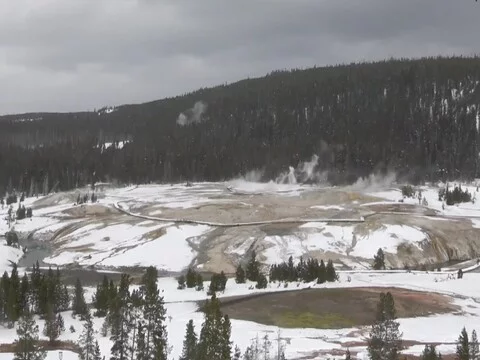
Averaged across the whole year that works out to a 52.8°F high, a 27.6°F low, and 72.1 inches of snow. The Yellowstone National Park live cam points at the Upper Geyser Basin, so it is the quickest way to see whether those averages match what the park looks like today.
Winter: December, January, and February
Winter here is cold and very quiet. Daytime temperatures sit between zero and 20°F for long stretches, sub-zero nights are routine, and the park record low is 66 below. Only one road stays open to regular cars: the North Entrance at Gardiner, Montana through to Cooke City.
That single open road is why the Yellowstone River cam at Gardiner earns its keep in January. The river stays open and dark against the snow while the hills above town go pale, and you can usually tell from the road surface whether the drive up from Livingston is a chore or a nightmare.
Everything else moves by snowcoach and guided snowmobile from mid-December to mid-March. West Yellowstone is the usual base for that, and rooms go early, so it pays to look at places to stay in West Yellowstone well before the season starts.
One honest warning about winter cams: the light is gone before 5 p.m. local, and several of the feeds around the park switch to a grainy black and white night mode. If you are watching from Europe, mid-afternoon your time is the middle of the night there.
Spring thaw: March through May
Spring is the least predictable stretch of the year. March still averages 13 inches of snow and highs under 40°F, April warms into the high 40s while crews plow, and May finally reaches 60.4°F. NPS warns that spring and fall can drop 12 inches of snow in a single 24-hour period, so a green morning can end white.

For a read on how much snow is still sitting on the western approach, the Island Park webcam in Idaho is better than any snow map. It looks at a plowed lot on the US-20 corridor toward the West Entrance, and when the banks there are still taller than the pickup trucks, the park interior is nowhere near open.
Road openings follow a strict order. In 2026 the West Entrance and the Madison, Norris, and Old Faithful roads opened on April 17, the East Entrance and Sylvan Pass on May 1, the South Entrance and Craig Pass on May 8, and Dunraven Pass plus the Beartooth Highway on May 22. Those last two are the high passes and they always go last.
Gardiner is the one gateway that works in any month, which makes hotels in Gardiner, Montana the safest booking if your dates land in that uncertain April window.
Summer: June, July, and August
Summer is warm, short, and stormier than most visitors expect. Highs run around 70°F in June and near 80°F in July and August at lower elevations. Nights stay cool and can still drop below freezing on high ground, and afternoon thunderstorms are common rather than rare.

The Gardiner cam is a different animal in July. Brown grass on the hills, hard blue sky, rafts on the water. Watch it for a few minutes in the afternoon and you will often catch a storm cell building over the ridge behind town, which is exactly the pattern that soaks people standing on a boardwalk at 3 p.m.
June is the wet end of summer and May is wetter still, so if your trip is early season, pack for rain and not just for heat. Guided wildlife and geyser tours in Yellowstone tend to start early enough to be back before the storms build.
September to November, when the park empties out
Early fall is the quiet reward. September still averages 67.8°F by day but only 37.0°F at night, October drops to 55.7°F with a few inches of snow, and November falls to 38.7°F as the interior roads close. The crowds thin out weeks before the weather turns.

Watch the high country to know where autumn actually is. The Big Sky Resort cam in Montana looks across at Lone Peak from Everett’s 8800, about an hour north of West Yellowstone, and the day that bare summit turns white is a fair signal that the passes are next.
Closing dates are firm and early. In 2026 Dunraven Pass and the Beartooth Highway shut on October 12, the rest of the interior roads on October 31, and most of the park is closed to regular vehicles from early November until late April. The Red Lodge webcam sits at the Montana end of the Beartooth Highway and is the first place you will see that road disappear under snow.
South of the park the season runs slightly longer, and things to do in Jackson Hole stay bookable well into October.
Which month should you actually go?
September, if you get one choice. Daytime highs are still in the sixties, the interior roads are all open until October 31, the elk are noisy, and the parking lots are a fraction of what they were six weeks earlier. Late September nights near freezing are the price.
July is the safe answer if you need warmth and every road open, and February is the interesting one if you want the park almost to yourself and do not mind traveling by snowcoach. April and November are the two months I would avoid without a specific reason. Both sit in the gap where roads are shut and the weather has nothing to offer.
Whichever way you lean, the cams do the arguing for you. Jackson Hole Town Square shows the southern approach in real time, and the wider Wyoming webcam collection and live cams across Montana fill in the country on either side of the park.
Worth knowing before you open a Yellowstone cam
The park runs on Mountain Time, which is UTC-6 in summer and UTC-7 in winter. Noon in Yellowstone during summer is 2 p.m. in New York and 7 p.m. in London. Plan around that or you will keep opening a black screen.
Daylight swings hard with the season. Around the summer solstice the sun is still up past 9 p.m. local; in late December it is gone before 5 p.m., which leaves a viewing window of roughly nine hours.
Feeds break, too. The Old Faithful stream is a scheduled broadcast rather than a permanent one, so there are hours when the embed simply has nothing to play. Snow settling on a lens, a frozen router, or a power cut at a remote gateway will all take a cam down for a day or two. If one feed is dead, try a neighboring town instead of assuming the whole region is offline. Our roundup of the best mountain webcams has more high-altitude options that behave the same way.
Frequently Asked Questions
What is the coldest month in Yellowstone?
January, by a clear margin. The National Park Service’s averages put the January high at 28.6°F and the low at 9.6°F, with roughly 14.5 inches of snow. Sub-zero nights are common, especially at higher elevations, and the all-time park record low is 66 degrees below zero.
Does it snow in Yellowstone in July?
Not in an average July, which is the only month alongside August that records zero snowfall in the park’s monthly figures. That said, most of Yellowstone sits above 6,000 feet and NPS states plainly that snow is possible in every month, so a summer flurry on a high pass is unusual but not shocking.
When do Yellowstone roads open after winter?
In stages through spring. For 2026 the West Entrance and central roads opened April 17, the East Entrance and Sylvan Pass May 1, the South Entrance and Craig Pass May 8, and Dunraven Pass and the Beartooth Highway May 22. Only the Gardiner to Cooke City road stays open to cars year-round.
Can you watch Old Faithful on a live webcam?
Yes. The Yellowstone National Park cam on our site carries a stream pointed at the Upper Geyser Basin, where Old Faithful erupts roughly every 90 minutes. It is a scheduled broadcast rather than a permanent one, so check during daylight hours in Mountain Time for the best chance of catching an eruption.
Yellowstone does not really have a bad month, only months that ask different things of you. Use the Yellowstone weather by month figures above to pick your dates, confirm them against the live feeds the week before you travel, and browse more landscape cams around the world while you wait for the roads to open.