
10 Best Mountain Webcams Around the World
The best mountain webcams around the world let you watch real snow, weather, and light on famous peaks right now, without leaving your chair. We run a directory of these feeds, so we know which ones deliver a clear view and which sit dark half the day. Below are ten mountain webcams worth watching, numbered one to ten and grouped by where they point, from Mount Fuji to the Swiss Alps to a glacier in Alaska.
The Alps still set the standard
For sheer density of good mountain cams, the European Alps are hard to beat. Three feeds stand out: St. Moritz in Switzerland, the Dolomites in Italy, and the Kitzbüheler Horn in Austria. Each looks out over a different kind of alpine terrain, and all three are easy to check before a trip.
1. St. Moritz, Switzerland
The St. Moritz webcam looks down the Engadin valley from above the town, with Lake St. Moritz sitting in the middle of the frame and peaks over 3,000 meters closing off the far end. The town itself sits at about 1,800 meters, so even in August the light comes and goes fast as cloud moves through. Watch for a few minutes near midday and you can usually tell whether the lake is flat calm or getting chopped up by wind.

If you are planning a stay, it helps to compare places to stay in St. Moritz while you watch the valley change through the day.
2. The Dolomites, Italy
Italy’s entry, the Dolomites cam at Rocca Pietore, points at the pale limestone walls that give the range its name. This is classic Cortina d’Ampezzo country, not far from the Tre Cime di Lavaredo. On a clear afternoon the rock warms to orange near sunset, which is honestly the best time to look.
3. Kitzbüheler Horn, Austria
Austria’s Kitzbüheler Horn cam sits at 1,996 meters above the town of Kitzbühel and looks across green summer meadows and the trails that thread down the slope. On a clear day you can pick out the Großglockner, the highest mountain in the country, off in the distance. There is a terrace with wooden benches in shot, so you often catch hikers stopping for a rest.
Fuji and the Himalayas anchor Asia
Asia brings the two most recognizable peaks on this list. The Mount Fuji cam shows Japan’s tallest mountain from the Fuji Five Lakes side, and the Annapurna feed looks straight at one of the highest ranges on Earth from a hillside in Nepal. Both cameras double as weather windows for climbers who are picking their day.
4. Mount Fuji, Japan
The Mount Fuji feed broadcasts from the Panoramic Ropeway station near Fujikawaguchiko, roughly 82 kilometers from Tokyo. Fuji is a 3,776 meter active volcano and one of Japan’s three holy mountains, and its climbing season runs July through September, so right now you are catching it at its busiest. The peak tends to hide behind cloud by late morning in summer, so early in the day is the safer window.

Thinking about the climb yourself? Browsing guided Mount Fuji tours is a good way to see what a summit push or an easier day trip actually involves.
5. Annapurna, Nepal
Higher and wilder, the Annapurna cam in Nepal streams from the Hotel Annapurna View at Sarangkot, above Pokhara. It faces Annapurna I, the tenth highest mountain on Earth at 8,091 meters and one of the deadliest to climb. Cloud and haze roll in constantly at this elevation, so a crisp view of the snow line is a genuine treat when you happen to catch it.
Which mountain cams are best in North America?
North America’s strongest feeds cover three very different scenes. Whistler in British Columbia frames a busy village below ski slopes, Big Sky in Montana points at a sharp granite summit, and the Mendenhall Glacier cam near Juneau shows a wall of blue ice. Between them you get resort life, backcountry, and raw wilderness.
6. Whistler, British Columbia
The Whistler Olympic Plaza cam sits in the middle of the village, about two hours north of Vancouver on the Sea to Sky Highway. You get the green plaza in front, the slopes of Whistler and Blackcomb behind, and a steady trickle of families and travelers crossing the grass. In summer there are free outdoor concerts here, and in winter the same spot becomes a skating rink.
7. Big Sky, Montana
Big Sky’s camera looks out from Everett’s 8800, a restaurant that sits at 8,800 feet, straight across at Lone Peak in Montana. That summit tops out at 11,166 feet above more than 5,800 acres of ski terrain, and Yellowstone’s west entrance is only about an hour away. In August the runs are brown and green, and the gondola cabins still run for sightseers heading up top.

8. Mendenhall Glacier, Alaska
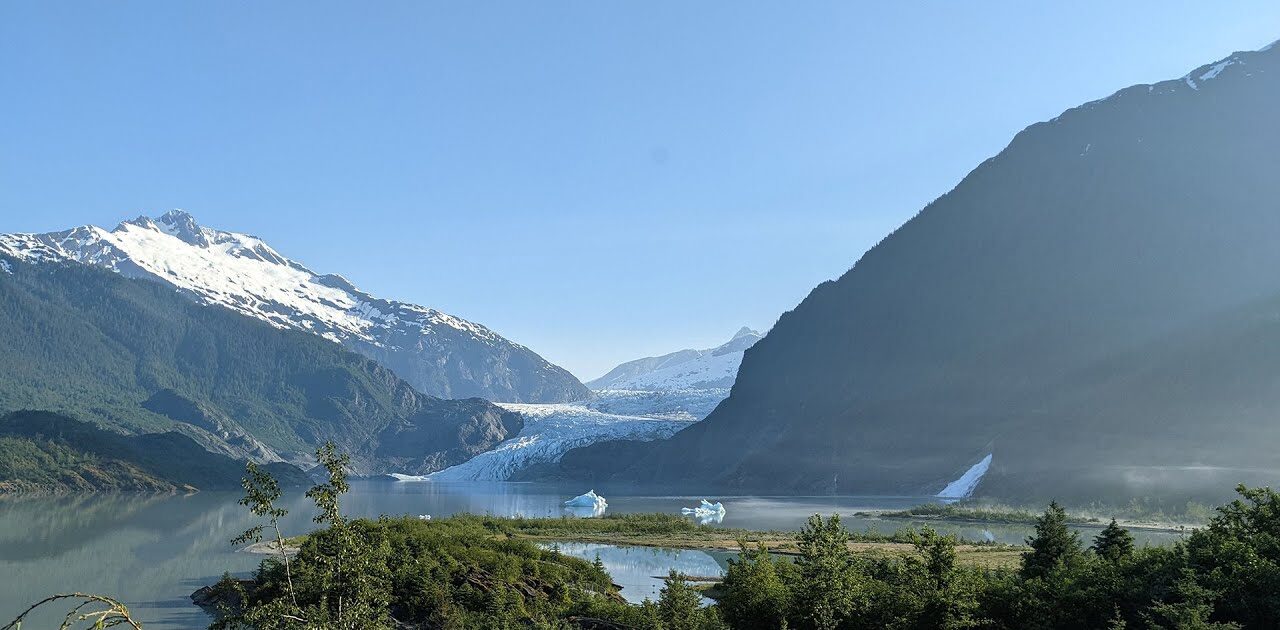
For a complete change of mood, the Mendenhall Glacier cam looks across Mendenhall Lake toward ice that flows down from the Juneau Icefield, about 12 miles from town. The glacier runs roughly 13 miles, and on clear mornings the face glows pale blue. After a calving event you can spot fresh chunks of ice drifting across the lake.
If you want to be there in person, it is worth checking hotels in Whistler village before the ski season fills the calendar.
Snow down under, and up in the Tatras
Two feeds round out the list from opposite corners of the map. Right now, in August, the Blue Cow cam at Perisher in Australia is deep in ski season while every northern cam shows green. The Zakopane cam in Poland’s Tatra Mountains covers a resort town that stays busy in both summer and winter.
9. Blue Cow at Perisher, Australia
Perisher sits in the Snowy Mountains of New South Wales and calls itself the largest resort in the Southern Hemisphere. Its season runs June to October, so the Blue Cow cam at Perisher is one of the few places you can watch fresh snow fall in August. You reach that part of the mountain on the Skitube Alpine Railway, which is odd enough to be worth a look on its own.
10. Zakopane, Poland
Over in Europe, the Zakopane cam sits at the foot of the Tatra Mountains in southern Poland, about 85 kilometers from Kraków. The town is known for its wooden Goral architecture and the busy Krupówki shopping street. It doubles as a good entry point to the wider family of ski slope cams we keep for the Alps, the Tatras, and beyond.

Worth knowing before you press play
A few practical habits make these mountain webcams far more useful. Because the ten sit across many time zones, at least one is always in daylight, so if Fuji is dark, Whistler or Perisher probably is not. High peaks hold snow much later than the valleys below them, and any feed can drop offline in a storm.
Time zones are the main thing to plan around. When it is midday in the Alps it is late evening in Japan and the middle of the night in Alaska, so pick a cam where the sun is actually up. Most feeds show a local clock plus sunrise and sunset times in the corner, which takes the guesswork out of it.
Snow lines matter too. In midsummer a peak like Lone Peak or the Kitzbüheler Horn looks brown and green low down while only the very top stays white. For the version with snow everywhere, the northern cams are best from roughly December to April, and the Australian cams look their best right now.
When a feed is frozen or black, it is usually weather or a short outage rather than a dead camera. Give it a few minutes, reload once, and if it is still down try another cam in the same region. If a whole area is socked in, jump to a different continent on the list where the weather is clear.
Frequently asked questions
Are mountain webcams live at night?
Most run around the clock, but the picture goes dark after sunset unless there is town lighting or a floodlit ski run in view. The St. Moritz and Whistler cams pick up village lights, while a wilderness feed like Mendenhall Glacier is essentially black until dawn. Check the local sunrise time shown on screen.
What is the best time to watch a mountain cam?
Late morning to early afternoon local time usually gives the clearest air and the fewest clouds sitting on the summit. Many peaks, Fuji especially, cloud over by midday in summer, so earlier is safer. For warm color on bare rock, the hour before sunset is hard to beat, particularly in the Dolomites.
Can I use these cams to plan a ski trip?
Yes, and it is one of their best uses. A live view tells you whether snow is actually falling, how much is on the ground, and whether the runs look busy, which a forecast alone cannot. For resorts, compare the on-mountain cam with the resort’s own snow report before you lock in a date.
Why does a webcam view look different from the photos?
Photos are usually shot in perfect light and then edited. A live feed shows the mountain exactly as it is at that moment, haze, cloud, and rain on the lens included. That honesty is the point. If a cam looks flat and gray, that really is the weather on the peak right now.
Keep exploring the peaks
Mountains are one of the few subjects where a live feed genuinely beats a photo, because the weather and light never sit still. Start with the two or three cams above that match the time of day where you are, then work through the rest of our mountain webcams when you want a different peak. The view is always changing, which is the whole reason to keep one open in a tab.