

Best Airport Webcams for Plane Spotting
Airport webcams are one of the few live feeds where something happens every couple of minutes. These are the best airport webcams for plane spotting on the site, twelve cameras pointed at real runways, aprons and approach paths across North America, the Caribbean, Europe and Japan. One carries live air traffic control audio. Another looks along a beach that arriving jets cross a few meters overhead.
Five North American fields worth keeping in a tab
North America gives you the most choice, largely because so many of these cameras are automated tracking rigs that swing onto whatever is moving. The five below cover a coastal mega-hub, a city-center field boxed in by water, a desert airport beside a casino strip, a compact Southwest base and Canada’s gateway to Quebec.
1. Los Angeles International (LAX)
The LAX runway camera sits on the roof of the H Hotel and looks west across the two southern runways, 25L and 25R. Aircraft touch down about 1.2 kilometers (0.75 miles) from the lens, then taxi in past the cargo aprons. Live air traffic control audio runs underneath the picture, so you often hear the clearance before the aircraft appears. Freighters work the small hours; the passenger banks build from first light.

That hotel turns up in most searches for hotels near LAX, and its runway-facing rooms look out on the same two strips.
2. LaGuardia (LGA)
New York’s closest-in commercial airport, in East Elmhurst, Queens. The camera tracks aircraft automatically, so it follows a regional jet along the taxiway, holds on a departure as it rolls, then swings back for the next arrival. On a clear day the Manhattan skyline stands about 10 kilometers (6 miles) behind the airfield. A perimeter rule introduced in 1984 caps most nonstop flights at 1,500 miles, so nearly everything crossing the LaGuardia webcam is a narrowbody or a regional jet on a short domestic run.
3. Las Vegas (LAS)
Harry Reid International sits roughly five miles south of downtown, right beside the Strip, which is why the skyline keeps turning up behind the aircraft. Four runways and a heavy Southwest presence keep the frame busy. The Las Vegas airport cam is the one we picked apart in a separate piece on how busy Harry Reid actually is right now.
4. Chicago Midway (MDW)
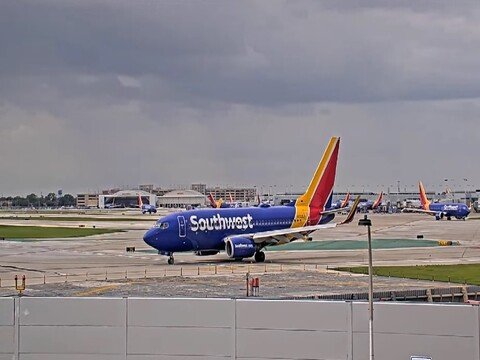
Midway is the close-up. The Midway camera sits low and near the taxiway, so aircraft fill the shot instead of crawling across a distant apron, and because it is fixed rather than panning, the framing never changes. Southwest 737s dominate, with business jets passing through. Midway handles about 20 million passengers a year across four concourses, second in the Chicago area behind O’Hare.
5. Montreal Trudeau (YUL)
Trudeau is in Dorval, about 20 kilometers from downtown Montreal, and it is the main air gateway to Quebec. The Montreal Trudeau feed is a slower watch than the American hubs: runway movements against a lot of open Canadian sky, with weather doing much of the work.
Which airport webcam is the most famous?
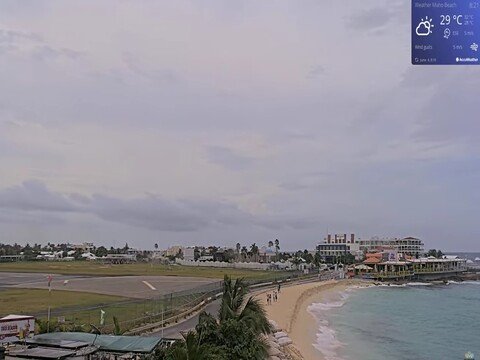
Princess Juliana International on Sint Maarten, almost certainly. The end of the runway is a few steps from Maho Beach, so arriving aircraft pass extremely low over the heads of people on the sand. That detail has made it among the most photographed airports anywhere, and it is why the beach has a spotting reputation at all.
6. Sint Maarten (SXM)
The Maho Beach camera points along the sand toward the runway threshold, which puts the crowd and the approach path in the same frame. Arrivals cluster around the inbound waves from North America and Europe, so early afternoon is usually liveliest, with the larger aircraft later in the day. Fair warning: the operator moves this one. At 08:02 local on the morning we checked, it was pointed at the palms and loungers of a beach bar rather than the runway.
Anyone planning to stand under that approach has options. There is no shortage of places to stay near Maho Beach, most of them inside the noise footprint by design.
Four European runways, four different jobs
Europe is where these cameras get opinionated. One of them watches a single strip of asphalt that carries an entire capital’s traffic, another is aimed at an apron rather than a runway, and the Istanbul feed burns a live data panel into the picture that names every movement.
7. Istanbul (IST)
Istanbul Airport is about an hour from the center, up near the Black Sea on the European side, and it took over from Ataturk as the city’s international gateway. The Istanbul airport webcam carries an AirNav Radar strip burned into the frame listing flight, aircraft, destination and status, so it doubles as a departure board. The airport links Europe, Asia and the Middle East, so the aircraft mix is broad.

8. Dusseldorf (DUS)
Dusseldorf is the apron watch. The camera looks across stands rather than down a runway, which makes it better for ground handling than for landings: pushbacks, belt loaders, catering trucks, the slow choreography between departures. Watch the Dusseldorf apron for twenty minutes and you will see a full turnaround. The airport lies 7 kilometers north of the city and serves the Rhine-Ruhr region.
9. Lisbon (LIS)
Humberto Delgado, still widely called Portela, runs everything on one runway: 02/20, 3,705 meters (12,156 feet) of asphalt. The Lisbon runway camera sits low beside the airfield with the rooftops of northern Lisbon on the horizon, and a bar across the top names each movement with airline, flight number, route, aircraft type and registration, plus a live temperature and wind reading. More than 414,000 people live within 5 kilometers of the airport, the highest figure of any major European airport, and the approach path runs over their roofs.
The city sits 7 kilometers southwest of the fence, so spotting folds easily into a trip built around tours and tickets in Lisbon.
10. Prague (PRG)
Vaclav Havel Airport opened in 1937 and sits in the Ruzyne district west of the city, ringed by open fields and suburbs. The Prague airport cam looks out along the approach, so aircraft come at you nose-on and grow in the frame rather than crossing it, and the mix runs from budget carriers to long-haul jets. One caveat from our own check: the runway sits low in the picture, so a flat overcast afternoon gives you mostly grey sky.

Tokyo has two airports, and the cameras show why
Haneda and Narita split Tokyo’s traffic, and their feeds look nothing alike. Haneda is a gate view, close in and constantly occupied, sitting far nearer the city. Narita is a runway view built around widebodies, roughly 60 kilometers out, and it is the one to open when you want long-haul metal rather than domestic shuttles.
11. Haneda (HND)
The Haneda camera looks along the Terminal 1 gates, so the quickest read on how busy it is comes from counting occupied stands and watching whether crews are working them. Japan Airlines and All Nippon Airways drive most of the movements. Haneda carries a heavy domestic schedule alongside international flights, and it was expanded and rebuilt ahead of the 2020 Tokyo Olympics.
12. Narita (NRT)
Narita looks out across Runway A with the nearest stands in the foreground, so departures rolling and widebodies parked at gates share the frame. Cathay Pacific and United turn up alongside the Japanese carriers. As Tokyo’s long-haul gateway, the Narita feed concentrates arrivals from North America and Europe in the afternoon and pushes departures out late morning and evening, with cargo filling much of the night. More cameras across the country sit in our Japan webcam collection.
Haneda is close enough in that spotters often stay on the airport itself. Search hotels near Haneda Airport and several have runway-facing rooms.
Worth knowing before you watch
Time zones catch people out more than anything else. Tokyo runs nine hours ahead of UTC, so both Japanese cameras are dark while Europe is at lunch, and the Americas are asleep when Narita’s morning bank runs. Work backwards from the airport’s local clock, not yours.
The cameras themselves fall into two types, and it matters. Fixed installations like Midway always show you the same thing, which is dull but dependable. Pan-tilt-zoom and tracking cameras, including LaGuardia and New Orleans, give far better shots when they lock onto an aircraft and nothing at all when they swing the wrong way.
Not every field on the site is a hub, either. Louis Armstrong New Orleans averages 1.4 meters (4.5 feet) above sea level, which makes it the third lowest-lying international airport in the world, and its camera sits beside runway 11 on an automatic tracker. Ilulissat in western Greenland is the opposite extreme: a small field about 2.8 kilometers from town, flown mostly by Air Greenland, where Arctic weather rearranges the schedule.
Feeds break, too. A stream can freeze on one frame for hours, a lens picks up rain and salt haze, and night views at smaller fields are close to useless. If one camera is dead, move to the next.
Frequently Asked Questions
What are the best airport webcams for plane spotting?
For sheer variety of aircraft, Istanbul and Narita are hard to beat, because both handle long-haul traffic from several continents. For drama, Sint Maarten wins, since jets cross Maho Beach a few meters above the sand. For picture quality up close, Chicago Midway sits nearest the action.
Can you hear air traffic control on an airport webcam?
On some of them, yes. The Los Angeles camera carries live air traffic control audio underneath the video, so you regularly hear a clearance issued before the aircraft it refers to enters the frame. Most other feeds are either silent or carry ambient airfield noise only, with no radio traffic.
What time of day is best for watching an airport webcam?
Mid-morning and late afternoon local time, when departure and arrival banks are running. Holiday airports concentrate their traffic mid-day and at weekends. Long-haul gateways such as Narita fill their afternoons with arrivals and their evenings with departures, while freight moves at many airports overnight, when the passenger terminals are quiet.
Are airport webcams free to watch?
Yes. Every camera listed here streams free, with no account, app or payment involved, and most run 24 hours a day. Some operators overlay their own branding or a flight data panel on the picture, and a few carry advertising, but access to the live view itself costs nothing.
The runway you actually want may be one these best airport webcams have not ranked. The full set, from Greenland heliports to Brazilian night approaches, sits in the airport webcams category, and our railway webcam roundup scratches the same itch at ground level.