
Live
Goldmine Mountain, California
Goldmine Mountain, Big Bear Lake, California, USA
 4.5°C / 40.1°F
 16:11
16:11 16:11:57
 18.5°C / 65.3°FScattered Clouds
 68%
68% 19 km/h / 12 mph
 06:56
06:56 18:23
18:23Loading forecast…
Goldmine Mountain, Big Bear Lake, California, USA
4.5°C / 40.1°F
16:11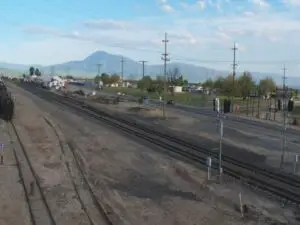


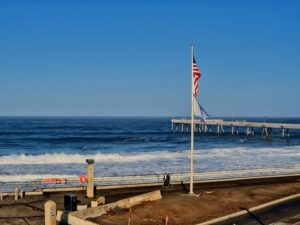


Aquarium of the Pacific, Aquarium Way, Long Beach, CA, USA
19.7°C / 67.5°F
16:11



Big Bear Valley Recreation and Park District, Park Avenue, Big Bear Lake, CA, USA
4.5°C / 40.1°F
16:11
Yosemite Valley, Sierra Nevada, California, USA
 11.7°C / 53.1°F
16:11
11.7°C / 53.1°F
16:11
Mori Point, Bradford Way, Pacifica, California, USA
 19.3°C / 66.7°F
16:11
19.3°C / 66.7°F
16:11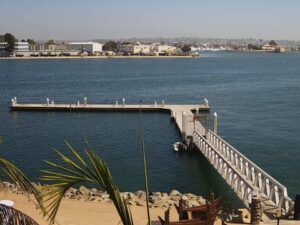

Planes on the ground and in the air within about 22 km (14 miles) of the airport, updated every 10 seconds. Tap a plane or a flight in the list for its details. Altitudes are above sea level. Positions come from volunteer ADS-B receivers, so some airports show few or no planes on the ground.
The LAX Airport Webcam looks west from the roof of the H Hotel toward the two southern runways at Los Angeles International Airport, 25L and 25R. Aircraft cross the frame on final approach, touch down about 1.2 kilometers (0.75 miles) from the camera, and taxi in past the cargo aprons. A second rooftop camera covers the northern pair, 24L and 24R, on the tab beside this one. Live air traffic control audio runs under the picture, so a clearance can be heard before the aircraft appears. Freighters work the small hours, and the passenger banks build from first light.
Los Angeles International Airport opened on October 1, 1928 and took its present name in 1949. It covers 3,500 acres (1,400 hectares) of Westchester, stands 39 meters (127 feet) above sea level, and handled 73.71 million passengers in 2025 across nine terminals and 161 gates.
Four runways run east to west in two parallel pairs, and that split is what divides the two cameras. In frame here is the south complex: 07L/25R at 3,939 meters (12,923 feet) and 07R/25L at 3,382 meters (11,095 feet). The north pair is shorter, so the field’s longest runway is the far one here. About 900 meters (0.6 miles) west, the 1961 Theme Building lifts its disc on four arches at the center of the terminal horseshoe.
The ocean keeps the airport mild rather than hot. August is the warmest month at 25 C (78 F) by day and 18 C (65 F) overnight, and July is effectively rainless. January is the cool end at 17 C (63 F) and 8 C (47 F), with April at 20 C (67 F) and October at 24 C (75 F). About 385 millimeters (15.1 inches) of rain falls in an average year, nearly all between November and March.
What changes this view most is not temperature but the marine layer. Damp air off the Pacific forms a deck of low cloud and fog along the coast overnight and into the morning, thickest in late spring, the season Southern California calls May gray and June gloom. On those mornings the LAX Airport Webcam shows flat gray light over the runways, and the cloud usually burns back before noon. Thick fog can push visibility below takeoff minimums and delay departures.
The In-N-Out Burger at 9149 South Sepulveda Boulevard, about 900 meters (0.6 miles) north of the hotel, lies under the approach to the north runways, and arriving aircraft pass low enough to read a registration from the parking lot. Clutter’s Park in El Segundo, a hilltop sidewalk park 2.4 kilometers (1.5 miles) from the camera, looks straight down the runways in this view and is the standard spot for departures off 25R.
The Flight Path Museum LAX at 6661 Imperial Highway, 2 kilometers (1.2 miles) south of the hotel, keeps the airport’s history in a former terminal building. The camera’s own vantage point is reachable, on the H Hotel rooftop deck marketed as the H Overlook.
Two more airport cameras and another Los Angeles view.
On the roof of the H Hotel on West Century Boulevard in Westchester, Los Angeles, about 1.2 kilometers (0.75 miles) east of runway 25R and 19 kilometers (12 miles) southwest of downtown.
Runways 25L and 25R fill the middle of the frame, with cargo aprons and the Westchester bluffs behind. Landings, takeoffs and taxiing traffic cross the view, and the second tab switches to 24L and 24R.
The wind almost always blows off the ocean, and aircraft land into it. More than 95 percent of departures head west over the coast, so arrivals approach from over the city. Santa Ana winds reverse that on fewer than 5 percent of days.
Four, in two parallel east to west pairs: 07L/25R and 07R/25L on the south side, 06R/24L and 06L/24R on the north.
It recorded 580,996 aircraft movements in 2025, about 1,590 a day, and holds the record as the world’s busiest origin and destination airport: roughly 88 percent of its passengers start or end their trip there.
Mild and dry, from 17 C (63 F) in January to 25 C (78 F) in August, with about 385 millimeters (15.1 inches) of rain a year.
Clutter’s Park in El Segundo, a hilltop park overlooking the southern runways.
Source: AirlineVideosLive+
The best new live webcams and site features, once a week.
By subscribing you agree to receive our weekly email. Unsubscribe any time.