Live
Mori Point, Pacifica, California
Mori Point, Bradford Way, Pacifica, California, USA
 23.7°C / 74.7°F
 15:19
15:19 15:19:02
 13.8°C / 56.8°F
 Broken Clouds
 37%
37% 20 km/h / 12 mph
 06:54
06:54 18:11
18:11Loading forecast…
Mori Point, Bradford Way, Pacifica, California, USA
23.7°C / 74.7°F
15:19


Aquarium of the Pacific, Aquarium Way, Long Beach, CA, USA
 30.9°C / 87.6°F
15:19
30.9°C / 87.6°F
15:19


Skid Row, Central City East, Los Angeles, USA
31.4°C / 88.5°F
15:19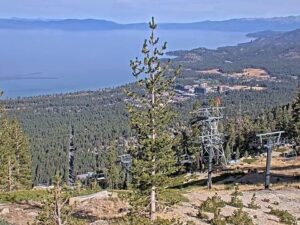



The Goldmine Mountain Webcam streams from Goldmine Peak in the San Bernardino Mountains of Southern California, 2,637 meters (8,650 feet) up on the ski hill above Big Bear Lake. This camera does not hold one view. It turns to a new angle every couple of minutes, so a few minutes of watching can take in forested ridgelines, the runs of the Bear Mountain ski area and the wider range beyond the valley. Socalmountains.com, a community news and forum site for the local mountain towns, runs the stream, and it also swings the camera toward major incidents in its coverage area, which makes it a useful check during fire season or a big winter storm. Snow changes the picture most. After a storm the ridges can turn white overnight, while summer brings back the dark green of the pine forest.
Goldmine Mountain is one of the three main peaks of Bear Mountain, the ski area above the Moonridge neighborhood of Big Bear Lake, alongside Bear Peak and Silver Mountain. The name once covered far more than a single summit. The resort opened in the early 1940s as the Moonridge Ski Area and traded as Goldmine Mountain from 1970 to 1987. S-K-I Ltd. bought it in 1988 and renamed it Big Bear Mountain, and in 2002 neighboring Snow Summit acquired it and settled on the current name, Bear Mountain. Today it is part of Big Bear Mountain Resort, owned by Alterra Mountain Company.
Bear Mountain runs from a base of 2,176 meters (7,140 feet) to a top elevation of 2,684 meters (8,805 feet), a vertical drop of 507 meters (1,665 feet). Seven lifts serve 80 hectares (198 acres) of terrain, and the longest run, Geronimo, is 2.4 kilometers (1.5 miles) from top to bottom. The mountain made its name on freestyle riding. Its Outlaw park, opened in 1992, is credited as the first freestyle terrain park in North America, and the resort still has Southern California’s only halfpipes. Snow Summit sits about 3.9 kilometers (2.4 miles) to the west.
Below the peak is the city of Big Bear Lake, at 2,058 meters (6,752 feet), home to 5,046 people at the 2020 census and about 40 kilometers (25 miles) northeast of the city of San Bernardino. The lake stretches about 11 kilometers (7 miles) and is roughly 1.6 kilometers (1 mile) across at its widest. The valley’s first boom came from gold rather than snow: its population grew quickly during the Southern California gold rush, which ran from 1861 to 1912.
Winter is when most people tune in. Down in Big Bear Lake, January averages a high of about 8 C (46 F) and a low near -5 C (23 F), and the town collects around 149 centimeters (58.6 inches) of snow a season. The peaks do better. Bear Mountain averages about 250 centimeters (100 inches) of natural snowfall, backed by snowmaking across the whole ski area. The camera sits roughly 580 meters (1,900 feet) above town, so conditions at the lens are typically colder than the town figures, and a storm can whiten the ridgelines in frame while the lakeshore stays wet and grey.
Summer is mild and mostly dry. July in Big Bear Lake averages highs near 27 C (80 F) and lows around 10 C (51 F), and the slopes on camera turn from white to green and brown as the snow melts out. Spring and fall are the swing seasons, when an early or late storm can dust the peaks for a few days at a time. Fire season changes how the stream is used. Socalmountains.com points it at major incidents within its coverage area, and the operator runs a live radio scanner from the same Goldmine site, so on a smoky afternoon the feed works as an informal lookout over the range.
In winter the obvious plan is to ride the terrain on screen. Bear Mountain’s 26 trails lean toward stronger skiers, with 40 percent rated intermediate and 30 percent advanced, and its 13 terrain parks are the main draw for snowboarders and freestyle skiers. In summer the resort switches to mountain biking, hiking and golf, and the Bear Mountain Golf Course sits at the foot of the slopes in Moonridge. For lift-served downhill riding, Summit Bike Park at Snow Summit runs gravity trails from 2,500 meters (8,200 feet).
Moonridge Road, just below the resort, is home to the Big Bear Alpine Zoo, a wildlife rehabilitation center that rescues, treats and releases native animals of the San Bernardino Mountains, and to a refurbished strip of restaurants and shops. The Big Bear Discovery Center is the San Bernardino National Forest’s visitor center for the valley and a good first stop for trail maps and forest conditions. Big Bear Lake itself, a short drive downhill, rounds out a day in the mountains.
These cams cover the same valley and other big California and mountain views.
Goldmine Mountain is in the San Bernardino Mountains of San Bernardino County, California, above the Moonridge neighborhood of Big Bear Lake. The city of San Bernardino is about 40 kilometers (25 miles) to the southwest.
The camera rotates through several views every couple of minutes, covering the San Bernardino Mountains and beyond, including the ridges and slopes around the Bear Mountain ski area. During a major incident such as a wildfire, the operator may point it at the affected area.
Winters are cold and snowy, with January lows near -5 C (23 F) in town and colder air at the peak. Summers are mild, with July highs near 27 C (80 F) down at the lake and cooler temperatures at 2,637 meters (8,650 feet).
The camera site on Goldmine Peak stands at 2,637 meters (8,650 feet). The highest lift-served point at Bear Mountain is 2,684 meters (8,805 feet), and the base area is at 2,176 meters (7,140 feet).
Goldmine Mountain is one of Bear Mountain’s three main peaks, and it was also the name of the whole ski area from 1970 to 1987. The resort became Big Bear Mountain in 1988 and has been called Bear Mountain since 2002.
Bear Mountain averages about 250 centimeters (100 inches) of natural snowfall a season, and the entire ski area is covered by snowmaking. The town of Big Bear Lake, lower down, averages around 149 centimeters (58.6 inches).
The camera is set to rotate between angles every couple of minutes rather than hold a single frame, so the scene on screen moves on its own. That is normal behavior, not a fault in the stream.
Source: Socalmountains.com
The best new live webcams and site features, once a week.
By subscribing you agree to receive our weekly email. Unsubscribe any time.