
Northern Lights Tonight
The live NOAA aurora forecast, where the northern lights may be visible tonight, and the webcams where you might catch them.
Tonight's aurora outlook
QuietAt Kp 2.33: Good chance across northern Canada, Greenland, Iceland and northern Scandinavia; possible low on the northern horizon in Alaska; unlikely further south.
Southern Hemisphere: the aurora australis is likely to stay over the Southern Ocean and Antarctica.
The Kp to latitude guidance is approximate (NOAA). You also need a clear, dark sky: clouds, a bright moon and city lights hide all but strong displays.
Live aurora forecast map
NOAA's OVATION model: the chance of aurora overhead in the next 30 to 90 minutes. The lighter part of the map is in daylight, and the pins are the webcams listed below.
- Webcam, dark now
- Webcam, not dark yet
Webcams where you might see it
Aurora activity is low right now, so no camera on the site sits under a strong part of the oval. These are the cameras closest to the auroral zone, where the aurora shows up first when activity picks up.
-
-
-
-
-
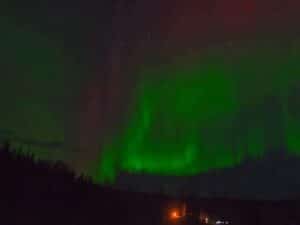
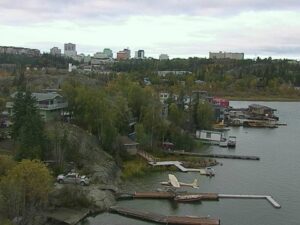 Dark now
Yellowknife, Canada
Dark now
Yellowknife, Canada
-
-

-

-
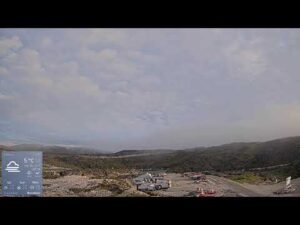
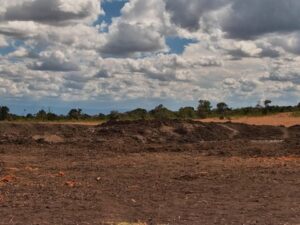 Daylight
Ol Pejeta, Kenya
Daylight
Ol Pejeta, Kenya
-
 Daylight
Gorilla Forest Corridor, Kasugho, DR Congo
Daylight
Gorilla Forest Corridor, Kasugho, DR Congo
-
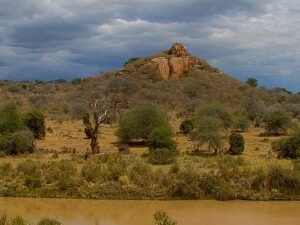 Daylight
Mpala Research Centre, Laikipia, Kenya
Daylight
Mpala Research Centre, Laikipia, Kenya
-
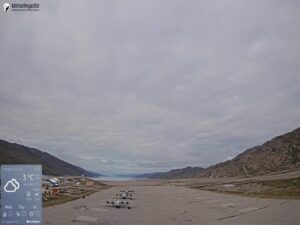 Daylight
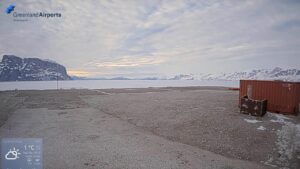
Kangerlussuaq Airport, Greenland
Daylight
Kangerlussuaq Airport, Greenland


None of these cameras is in darkness right now. Clear the filter to see them all.
3-day Kp forecast
NOAA's planetary Kp index in 3-hour blocks from midnight UTC today: observed so far, then NOAA's estimate and forecast. Tap or hover a bar to see it in your local time.
- Quiet (below 4)
- Active (4)
- G1 (5)
- G2 (6)
- G3 (7)
- G4 (8)
- G5 (9)
- Striped: predicted
| Block (UTC) | Kp | Type |
|---|---|---|
| Sun, Oct 18 00-03 | 2 | observed |
| Sun, Oct 18 03-06 | 2.33 | observed |
| Sun, Oct 18 06-09 | 2 | observed |
| Sun, Oct 18 09-12 | 1.33 | estimated |
| Sun, Oct 18 12-15 | 1.33 | estimated |
| Sun, Oct 18 15-18 | 1.33 | estimated |
| Sun, Oct 18 18-21 | 1.33 | estimated |
| Sun, Oct 18 21-00 | 1.67 | estimated |
| Mon, Oct 19 00-03 | 2.33 | predicted |
| Mon, Oct 19 03-06 | 2 | predicted |
| Mon, Oct 19 06-09 | 1.33 | predicted |
| Mon, Oct 19 09-12 | 2 | predicted |
| Mon, Oct 19 12-15 | 2.33 | predicted |
| Mon, Oct 19 15-18 | 2.67 | predicted |
| Mon, Oct 19 18-21 | 3.67 | predicted |
| Mon, Oct 19 21-00 | 4 | predicted |
| Tue, Oct 20 00-03 | 4.33 | predicted |
| Tue, Oct 20 03-06 | 4.67 | predicted |
| Tue, Oct 20 06-09 | 3.67 | predicted |
| Tue, Oct 20 09-12 | 3 | predicted |
| Tue, Oct 20 12-15 | 3 | predicted |
| Tue, Oct 20 15-18 | 3 | predicted |
| Tue, Oct 20 18-21 | 3.33 | predicted |
| Tue, Oct 20 21-00 | 3.67 | predicted |
How to read the aurora forecast
Kp measures how disturbed the Earth's magnetic field is, from 0 (calm) to 9 (an extreme storm). NOAA publishes it for every three-hour block, keeps a running estimate for the current block and forecasts it three days ahead. The higher it climbs, the farther from the poles the aurora spreads, which is why the outlook above names places rather than just a number.
The aurora follows the magnetic field, so the outlook works in geomagnetic latitude rather than the latitude on a map. North America sits closer to the magnetic pole than Europe does: Duluth, Minnesota, about 10 degrees farther south than Inverness, Scotland, on a map, is actually slightly better placed for the northern lights. Iceland and Norway, meanwhile, sit right under the auroral oval.
The map shows NOAA's OVATION model, a short-term forecast of where the aurora is overhead. The webcam list ranks cameras by that chance at their location and marks whether the sun is more than 12 degrees below the horizon there, because a camera in daylight or bright twilight cannot show the aurora however strong it is.
Kp needed, by region
Roughly the Kp at which the aurora may appear, at least low on the poleward horizon. Approximate, based on NOAA's guidance.
| Where | Kp needed (approx.) |
|---|---|
| Alaska | Almost any |
| Northern Canada | Almost any |
| Greenland | Almost any |
| Iceland | Almost any |
| Northern Scandinavia | Almost any |
| The Faroe Islands | 3 |
| Southern Canada | 4 |
| Shetland | 4 |
| Southern Finland | 4 |
| The northern tier of U.S. states | 5 |
| Southern Scandinavia | 5 |
| The Great Lakes | 6 |
| The Pacific Northwest | 6 |
| Scotland | 6 |
| Denmark | 6 |
| New England | 7 |
| Ireland | 7 |
| Northern England | 7 |
| Northern Germany | 7 |
| The central U.S. | 8 |
| The Mid-Atlantic | 8 |
| The Netherlands | 8 |
| Southern England | 8 |
| Central Europe | 9 |
| The southern U.S. | Only extreme storms |
| Southern Europe | Only extreme storms |
| Where | Kp needed (approx.) |
|---|---|
| The south of New Zealand | 6 |
| Tasmania | 6 |
| The rest of New Zealand | 7 |
| Victoria | 8 |
| Mainland southern Australia | Only extreme storms |
Northern lights FAQ
Can I see the northern lights tonight?
It depends on three things: how active the geomagnetic field is, how close you are to the auroral zone, and whether your sky is dark and clear. The verdict at the top of this page combines NOAA's live Kp index and its forecast for the next 24 hours with the approximate latitude the aurora reaches at that level. If your area is listed as a good chance, get away from city lights and look toward the poleward horizon (north in the Northern Hemisphere, south in the Southern Hemisphere) from late evening into the early hours.
What does the Kp index mean?
Kp is NOAA's planetary index of geomagnetic activity, on a scale from 0 to 9 in three-hour blocks. It is published in thirds, so 3.67 means "4 minus". The higher the number, the brighter the aurora and the farther it spreads from the poles: as a rule of thumb from NOAA, the edge of the auroral oval moves about 2 degrees of geomagnetic latitude toward the equator for each step. Kp 5 and above is a geomagnetic storm on NOAA's G scale, from G1 (minor) at Kp 5 to G5 (extreme) at Kp 9.
What Kp do I need to see the aurora where I live?
Roughly: almost any Kp in Alaska, northern Canada, Greenland, Iceland and northern Scandinavia; about Kp 3 in the Faroe Islands; about Kp 4 in southern Canada, Shetland and southern Finland; about Kp 5 in the northern tier of U.S. states and southern Scandinavia; about Kp 6 in the Great Lakes, the Pacific Northwest, Scotland, Denmark, the south of New Zealand and Tasmania; about Kp 7 in New England, Ireland, northern England, northern Germany and the rest of New Zealand; about Kp 8 in the central U.S., the Mid-Atlantic, the Netherlands, southern England and Victoria; and about Kp 9 in central Europe. Closer to the equator than that it takes a rare, extreme storm. These are averages from NOAA's guidance, and a real night can beat them or fall short.
What is the best time of night to see the northern lights?
NOAA's advice is that the best aurora is usually within an hour or two of local midnight, roughly 10 p.m. to 2 a.m., and that the window widens toward evening and morning as activity rises. It also has to be properly dark: this page counts a place as dark when the sun is more than 12 degrees below its horizon. Close to the poles that never happens in summer, which is why aurora season in places like Alaska, Iceland and northern Norway runs roughly from late August to mid-April.
Why do clouds and the moon matter?
The aurora glows about 100 km (60 mi) and more above the ground, far above the weather, so any cloud between you and it hides it completely: a clear sky matters as much as a high Kp. A bright moon, like city lights, does not change the aurora itself but washes out its fainter parts, so dark nights around the new moon, away from towns, show the most. A strong display is still easy to see under a full moon.
Where is the best place to see the northern lights?
Under the auroral oval, which sits over roughly the same band every night: northern Norway, Sweden and Finland (Tromsø, Abisko, Rovaniemi), Iceland, Alaska (Fairbanks), northern Canada (Yellowknife, Whitehorse) and Greenland. There, even a quiet night with Kp 2 or 3 often puts on a show. Pick a spot with a clear, dark view toward the pole (a hilltop or a lake shore works well). In the Southern Hemisphere the aurora australis is seen most often from Tasmania, the south of New Zealand's South Island and Antarctica.
Can webcams really show the aurora?
Yes, on the right night. A camera needs a dark sky, a view toward the pole and a sensor that copes with faint light. Many webcams are tuned for daytime, so a weak aurora may show as little more than a green tint while a strong one is obvious. The chance on each webcam card is NOAA's OVATION estimate of aurora overhead at that spot right now, and the dark badge means the sun is more than 12 degrees below the horizon there. Cameras in the Southern Hemisphere can catch the aurora australis.
How accurate is the aurora forecast?
The OVATION map is a short-term forecast driven by the solar wind measured by spacecraft about 1.5 million km (930,000 mi) upstream of Earth, so it is best for the next 30 to 90 minutes. The 3-day Kp forecast is less certain, because the arrival time and strength of an eruption from the sun can be off by many hours. NOAA's Kp to latitude guidance is an average too: use it as a rule of thumb, then check the sky.