Live

Stream hours: Seasonal nest cam. Outside the nesting season, which runs roughly from late January into July, the stream may show replays of past seasons instead of a live view.
 09:37:58
 22°C / 71.6°F
 Overcast Clouds
 49%
49% 7 km/h / 4 mph
 06:54
06:54 18:27
18:27Loading forecast…
Big Bear Valley Recreation and Park District, Park Avenue, Big Bear Lake, CA, USA
13.8°C / 56.8°F
09:37
Goldmine Mountain, Big Bear Lake, California, USA
13.8°C / 56.8°F
09:37
Kitten Rescue Sanctuary, Los Angeles, California
21°C / 69.8°F
09:37


Skid Row, Central City East, Los Angeles, USA
20.5°C / 68.9°F
09:37
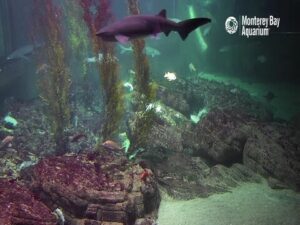
Monterey Bay Aquarium, Cannery Row, Monterey, CA, USA
 16.3°C / 61.3°F
09:37
16.3°C / 61.3°F
09:37


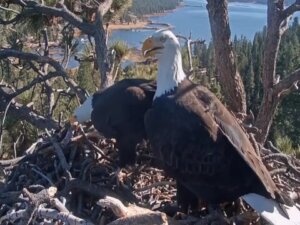
The West End Bald Eagle Webcam looks into a long-used bald eagle nest on a sea cliff at the West End of Santa Catalina Island, about 47 kilometers (29 miles) south-southwest of Long Beach. The main camera is the operator’s “Medium View”, framing the nest bowl with the perches and cliffside around it, and the Low Cam tab moves in for close-ups of the nest interior. The Institute for Wildlife Studies (IWS) runs the cameras with explore.org as part of a bald eagle restoration program that began in 1980. The nest has been active since 1991 and streamed since 2005. Outside the nesting season the stream may show replays of past seasons instead of a live view, labeled HIGHLIGHT with the original date in the top corner.
Catalina is 35 kilometers (22 miles) long, and the West End is its far western part, beyond the narrow isthmus at Two Harbors. IWS calls the site the West End Territory and does not publish the nest’s exact position, so the map pin marks the island’s West End rather than the cliff itself. In daylight recordings from the stream, the adults stand on a broad stick nest against a lichen-covered gray rock face, and a wider shot looks down a ridge of rock and scrub to the open sea. The cameras are an educational partnership between IWS, the Montrose Settlements Program, the Santa Catalina Island Conservancy and explore.org.
Bald eagles once nested on all eight California Channel Islands and had vanished by 1960, poisoned by the pesticide DDT. Between 1947 and 1961, large amounts of DDT-contaminated sludge were dumped offshore of Catalina. IWS began reintroducing eagles in 1980, but the first eggs, laid in 1987, broke soon after. For 20 years the team kept the population going by swapping fragile eggs for artificial ones and fostering healthy chicks back into the nests. In 1991 a healthy egg from Frenchman Lake in Plumas County was placed in this nest, and the chick that hatched, K-13, fledged. From 1992 to 2005 the male Shenandoah shared the nest with two females, Wray and Diana, both brought from Vancouver Island in British Columbia and released on Catalina in 1986.
The cast keeps changing. Thunder, a female hatched at the Two Harbors nest in 2009, raised three chicks here with the male Akecheta in 2022 and again in 2024. She laid two eggs in February 2025, ravens took both, and she was last seen on February 28 that year. In 2026 a new pair moved in: the male 29/D, known as Lee, hatched at Seal Rocks on Catalina in 2022, and an unbanded female that livestream followers named Isla. Isla laid an egg on March 15, 2026, ravens broke it the next day while the nest was unattended, and the pair did not try again that season.
Catalina has a mild maritime climate. In the island’s NOAA record for 1981 to 2010, January afternoons average 60.4 F (15.8 C) with nights near 49.5 F (9.7 C), while August reaches 77.6 F (25.3 C) by day and 61.7 F (16.5 C) after dark. About 349 millimeters (13.7 inches) of rain falls in a year. Ten-year model averages for the West End put roughly three quarters of it between December and March, exactly when the eggs are laid and incubated.
Spring dries out quickly, with April and May averaging about 10 millimeters (0.4 inches) of rain a month at the West End as the chicks grow. June to September is close to dry, with West End highs climbing from about 66 F (19 C) to 72 F (22 C) while the young take their first flights. October stays warm, and the rains return in November and December. After dark the nest cameras switch to black-and-white infrared.
Two Harbors, the island’s second and much smaller resort village, sits on the isthmus between the main body of Catalina and the West End. The Trans-Catalina Trail crosses the island from Avalon, and its current official route of about 62 kilometers (38.6 miles) loops out to Parsons Landing on the West End and back to Two Harbors. Starlight Beach, near the western tip, was the trail’s original finish. Mount Orizaba, the highest point on Catalina, rises to 639 meters (2,097 feet).
The Santa Catalina Island Conservancy protects about 170 square kilometers (42,000 acres), roughly 88 percent of the island. Another eagle camera, the Two Harbors Bald Eagle Cam, overlooks the small village of Two Harbors, and Big Fisherman Cove, close to the village, has its own underwater live camera. Offshore, the waters around Catalina see a different kind of traveler in spring and summer: sooty shearwaters from New Zealand, which spend the northern summer off California as part of a loop around the whole Pacific traced on our bird migration map.
More eagle nests and another view of Catalina Island:
On a sea cliff at the West End of Santa Catalina Island, California, beyond the isthmus at Two Harbors. Catalina lies about 47 kilometers (29 miles) south-southwest of Long Beach. IWS does not publish the exact nest site.
The main camera frames the nest bowl, nearby perches and the cliffside, and the Low Cam tab shows the nest interior up close. In season, the pair lays and guards its eggs there and feeds the chicks until they fly.
Outside the nesting season the stream may show replays of past seasons, labeled HIGHLIGHT with the original date in the top corner, instead of a live view. In the IWS records, eggs are mostly laid between late January and early March, chicks hatch in March or April, and the young make their first flights between early June and mid-July, so winter to early summer is the time to watch for live action at the nest.
At the West End nest, IWS has logged first eggs as early as January 29 (in 2022) and as late as mid-March, with hatching about five to six weeks later.
Mild all year. January highs average about 60 F (16 C) and August highs about 78 F (25 C) in the island’s NOAA record, and most of the rain falls from December to March.
Since 2026, the male 29/D, called Lee, and an unbanded female named Isla. Their first egg, laid on March 15, 2026, was broken by ravens the next day.
DDT. Contaminated sludge dumped offshore between 1947 and 1961 left eagles unable to hatch their young, and bald eagles were gone from the Channel Islands by 1960. IWS has worked to bring them back since 1980.
Source: Explore Eagle Nest Cams (Institute for Wildlife Studies and explore.org)
The best new live webcams and site features, once a week.
By subscribing you agree to receive our weekly email. Unsubscribe any time.
 11.4°C / 52.5°F