
10 Best Lighthouse Webcams You Can Watch Live
The best lighthouse webcams point at towers still doing a job, not at museum pieces behind glass. The ten below all run live, and between them they cover a foggy Maine channel, a granite point in Nova Scotia, two very different Florida coasts, a cliff above Lake Superior and a fossil reef in New Zealand. Watching one is the cheapest way to find out what the sea is doing somewhere else today.
New England keeps four of them running
New England has more working light stations than any other stretch of the United States, and four of them carry cameras we can point you at. Maine supplies two, Massachusetts and Rhode Island one each. All four face the open Atlantic, which means fog is the thing most likely to take the view away.
1. Nubble Lighthouse, York, Maine
Cape Neddick Light stands about 91 meters (300 feet) off the eastern tip of the cape, on a rock islet everyone calls the Nubble. The Nubble Lighthouse webcam watches from beside Fox’s Lobster House at the end of Sohier Park Road, which is as close to the station as anyone gets, because the island itself is closed. The tower is only 12 meters (41 feet) tall, but the rock lifts its light to 27 meters (88 feet) above the sea, and that is why so short a lighthouse carries so far.
Sky fills the upper half of the frame, so weather is usually the first thing you notice. The light burns around the clock rather than only after dark, showing isophase red on a 5 second cycle. Open the cam on a weekday lunchtime in September and the parking lot in the foreground is still half full, with people walking down to the rail for a photograph.
2. Marshall Point Lighthouse, Port Clyde, Maine
You have probably seen this one without knowing its name. The raised wooden walkway running out to the squat 1857 tower is where Forrest ends his run in Forrest Gump, and it cuts straight through the middle of the frame. The camera at Port Clyde Harbor looks from the shore behind the keeper’s house, over ledge and cobble that go under as the tide returns.

Lobster boats and the Monhegan Island mail boat cross the channel through the day, and the grounds open from sunrise to sunset, so walkers on the ramp are a regular part of the picture. One keeper dominates the record: Charles Clement Skinner tended this light from 1874 to 1919, the longest run any keeper served at a single lighthouse in the history of the U.S. Lighthouse Service. The walkway is also the most exposed structure on the point, rebuilt in the autumn of 2017 and damaged again by a storm in January 2024.
3. Gay Head Lighthouse, Aquinnah, Massachusetts
The red brick tower at the western tip of Martha’s Vineyard is not standing where it was built. Clay and sandstone cliffs under it retreat by roughly 0.6 meters (2 feet) a year, and by 2015 the light sat 14 meters (46 feet) from the drop, so a crew jacked up all 400 tons of it and rolled it about 39 meters (129 feet) inland. The Aquinnah cliffs camera streams from a shop at the overlook and takes in the circle, the open grass around the station and the water past the treeline.
Since 1988 the characteristic has been one white flash and one red, simplified from the three whites and one red that earlier keepers maintained. Gay Head is the only lighthouse in the United States with a documented record of Native American head keepers, and the land around it belongs to the Wampanoag Tribe of Gay Head (Aquinnah). Summer fills the overlook with cars and walkers. By late autumn the same shot empties out to grass, road and sea.
4. Watch Hill Lighthouse, Westerly, Rhode Island
Rhode Island ends here, where Block Island Sound and Fishers Island Sound run into each other. The 1856 tower is gray Westerly granite, 13.7 meters (45 feet) tall and built onto the corner of a two-story brick dwelling, and the Watch Hill camera stands on the station lawn behind the seawall, so water fills most of the shot and a low shoreline closes the horizon.
The Great New England Hurricane of September 1938 nearly took the station apart: waves broke over the top of the tower, smashed the lantern windows and destroyed the sea wall. Montauk Point Light stands 26 kilometers (16 miles) due south on the far side of the sound, and Stonington in Connecticut is 5.3 kilometers (3.3 miles) across the water. A flat morning here can turn to hard chop by afternoon.
York makes a practical base if you want to see this coast in person: places to stay in York, Maine. More cameras sit up the shore in our Maine webcam collection.
Which lighthouse webcam is the most famous?
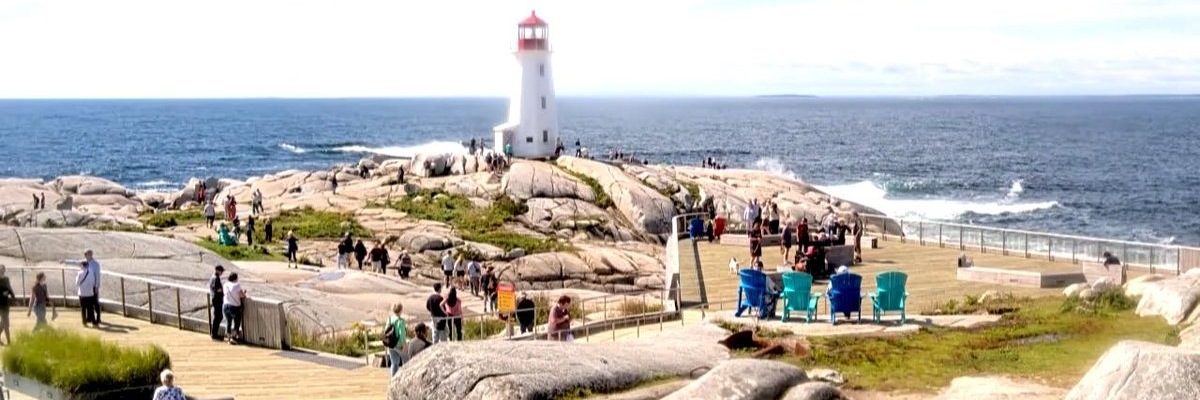
Peggy’s Cove has the strongest claim. The white tower with the red lantern room, sitting on bare granite on the eastern shore of St Margarets Bay, is the image most people have in mind when they think of Atlantic Canada, and its camera is busy enough that you will rarely catch the rocks empty in daylight.
5. Peggy’s Cove, Nova Scotia
The present tower dates from 1915, stands about 15 meters (49 feet) tall and rests directly on smooth coastal granite, roughly 43 kilometers (27 miles) southwest of Halifax. The village itself has only a few dozen year-round residents and takes visitors from everywhere. Open the Peggy’s Cove webcam around midday and the boardwalk deck below the light fills up, blue and teal chairs facing the water, surf working the right-hand side of the point.
Wet granite here is genuinely dangerous, which is why the warning signs in shot are so blunt and why the viewing deck was built where it was. Fog, rough seas and fast-moving cloud are all common, and the cove keeps working through them: fishing gear, sheds and boats sit in the harbor just out of frame. Halifax is close enough for a half-day trip, and guided tours out to Peggy’s Cove run from the city most of the year.
6. Baccaro Point Lighthouse, Nova Scotia
Baccaro is the opposite experience, and a useful corrective if the crowds at Peggy’s Cove put you off. This is the southernmost point of mainland Nova Scotia, and the Baccaro Point camera faces open Atlantic with a square white wooden tower standing on bare rock at one edge of the frame.

Wind is the constant. On a rough day the swell breaks white the whole way across the shot, and on a calm one you can pick out fishing boats working the ground offshore. Keepers once painted black circles on three faces of the tower so mariners could tell it apart from other lights along this coast in daylight, and the foghorn was retired in 2014. The name is the oldest recorded in the province, from the Basque word baccalaos, meaning codfish, left by crews who worked these banks long before anyone settled here. More of the coast sits in our Nova Scotia webcam list.
Two Florida towers doing completely different jobs
Florida gives you warmth, long daylight and two cameras with almost nothing in common. One looks down from the gallery of a working cast iron tower over a busy inlet north of Fort Lauderdale. The other is mounted on a rebuilt brick lighthouse in the middle of a quiet barrier island on the Gulf coast.
7. Hillsboro Inlet Lighthouse, Hillsboro Beach
The Hillsboro Inlet camera shoots from the gallery itself, looking south. Two rock jetties reach into the Atlantic with a pale sandbar shifting between them, the beach runs away toward Pompano Beach, and on a clear day the high rise line of Fort Lauderdale stacks up on the horizon.

Boats pass through the cut all day, because this is the working channel between the Intracoastal Waterway and the open ocean, and the water changes colour hour by hour from flat gray under a squall to the banded green and blue of the reef edge. Locals call the tower the Big Diamond, after the diamond shaped panes in its lantern room. The whole thing was cast in Detroit in 1905, shipped roughly 4,000 nautical miles by way of the Great Lakes, the Mississippi and the Gulf, then barged north up the coast. Its second order Fresnel lens, first lit on March 8, 1907, is still in place and still turning, which almost no other American light can claim.
8. Cape St. George Lighthouse, St. George Island
This tower fell into the Gulf in October 2005. About 24,000 of its roughly 160,000 original bricks were pulled back out of the water and worked into a replacement, raised on safer ground in the center of the island and opened to the public in December 2008. The St. George Island webcam looks south from the rebuilt tower over two open sided pavilions, a timber boardwalk and a wide strip of sand, with the Gulf filling the top half of the frame.
The high angle puts the whole strip in shot at once, including the warning flag on the dune crossing, which is the fastest way to read the day’s conditions. St. George Island runs 45 kilometers (28 miles) long and about 1.6 kilometers (1 mile) across at its widest, with a permanent population of 990, so the beach is often close to empty outside the summer weeks. Beds go fast in season, so check places to stay on St. George Island early, or browse our Florida live cameras and the roundup of live beach webcams in the USA.
A cliff on Lake Superior and a reef in the Pacific
These last two are the outliers. One is freshwater, filmed from a few meters away on a 40 meter (130 foot) cliff in Minnesota. The other sits on the east coast of New Zealand’s North Island, which puts it roughly 16 hours ahead of the U.S. East Coast and wide awake while the American cameras are dark.
9. Split Rock Lighthouse, Minnesota
The Split Rock Lighthouse webcam is mounted right beside the tower, close enough that the yellow brick octagon fills the right of the frame and the twin diaphone fog horns cut across the corner above it. Lake Superior takes the left, running out past a low wooded headland, and the water sets the mood: pale and flat on a calm morning, dark blue under a high sun, grey and broken when wind runs down the lake.
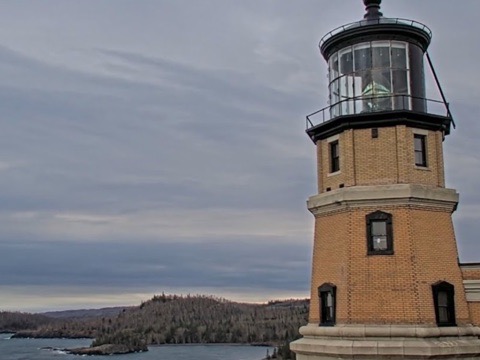
One storm built this station. The Mataafa Storm of November 1905 damaged or destroyed 29 vessels and killed 36 seamen, shipping interests pressed for a light on this shore, and the lamp was first shown on July 31, 1910. No road reached the cliff then, so every sack of cement and every piece of the tower arrived by water and went up the rock face on a crane. The beacon was deactivated in 1969, though the Minnesota Historical Society, which runs the site as a museum for roughly 160,000 visitors a year, still lights it once a year, every November 10, for the Edmund Fitzgerald. Hotels in Two Harbors, Minnesota put you about twenty minutes down the shore.
10. Castlepoint Lighthouse, New Zealand
Castlepoint sits on the Wairarapa coast of the North Island, and its light was first shown in 1913 from a tower roughly 23 meters (75 feet) tall on a rocky headland. Behind it lies Castlepoint Reef, one of the largest fossil reef systems in the country, with Castle Rock rising over the shoreline.
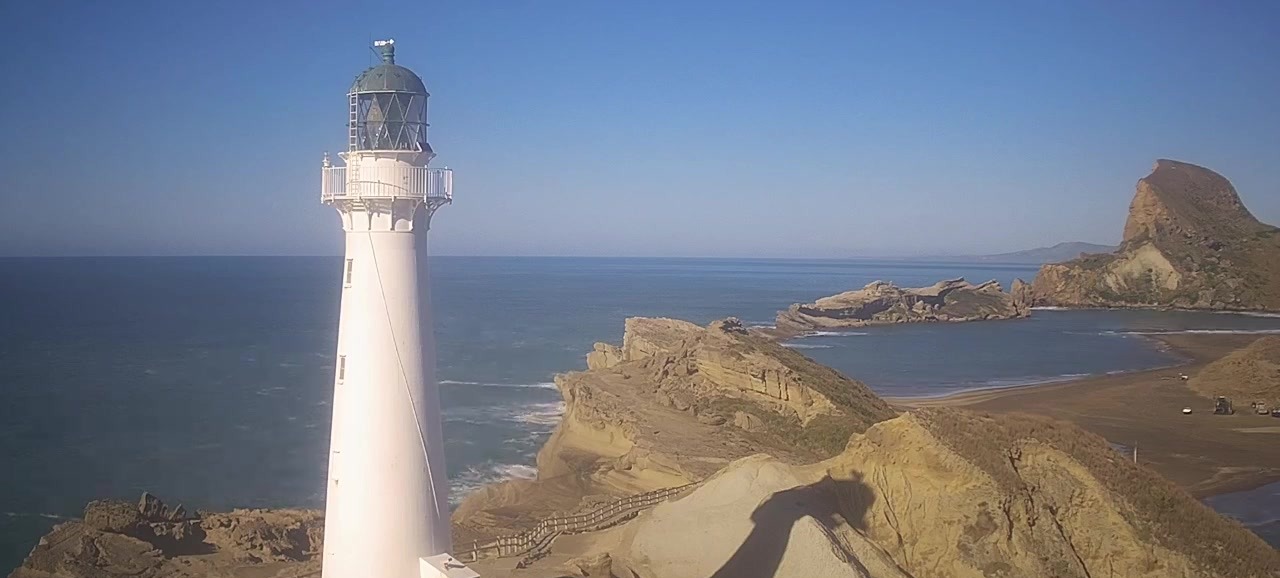
Swell breaking on that reef is the main event on the Castlepoint webcam, and it gets big when a southerly runs up the coast in winter, which is June to August down there, with temperatures typically between 7 and 14°C (45 to 57°F). Summer afternoons are calmer and busier, with people out on the sand below the headland and seabirds working the cliffs. This is the one cam on the list that is awake when the rest are asleep.
Worth knowing before you open one
The weather that makes a lighthouse interesting is the same weather that hides it. Sea fog forms when warm air drifts over cold water, so Maine, Nova Scotia and Martha’s Vineyard can lose a tower for an hour in early summer and hand it back just as fast. That is not a broken feed, and waiting usually fixes it.
Daylight is the other thing to plan around. Nine of the ten sit in North American time zones, so European viewers get the good light late in the afternoon, while Castlepoint runs opposite and rewards an early start. Autumn is quietly the best season for most of these cams: the air on the Maine and Nova Scotia coast is at its clearest, and the Atlantic hurricane season pushes long swell onto the rocks in otherwise calm weather.
Night viewing is poor nearly everywhere. The lights themselves keep working, and their characteristics are all different: Nubble shows isophase red on a 5 second cycle, Hillsboro Inlet flashes white every 20 seconds, Wood Island alternates green and white every ten. A camera pointed at a black sea still gives you very little.
Three towers did not make the ten and are still worth a look. Marblehead on Lake Erie was first illuminated in 1822 and is the oldest continuously operating lighthouse on the Great Lakes, with the ferries to South Bass Island crossing in front of it. Wood Island off Biddeford Pool was the thirteenth lighthouse completed in the United States, and its 1839 granite tower replaced a wooden one an inspector found rotten in 1833. Over in Indiana, the Michigan City camera frames the 1904 East Light at the end of a pier, above a beach that fills with umbrellas in July and empties completely by November. Fixed cameras with constant movement in them are also what makes our airport webcam roundup work.
Frequently Asked Questions
What are the best lighthouse webcams to watch right now?
Peggy’s Cove in Nova Scotia and Split Rock in Minnesota are the two to open first, because both cameras sit close enough to frame the tower properly instead of showing a white speck on a headland. Nubble is the classic American view, and Hillsboro Inlet offers something the others cannot, a look down from a working gallery.
Are lighthouse webcams live at night?
The streams keep running, but there is little to see. These are daylight cameras, and a dark sea gives them nothing to work with. The lights themselves still turn through the night, so on a clear evening you may catch the characteristic flash. That is about the extent of it on most feeds.
Why does a lighthouse webcam show nothing but gray?
Fog, nearly always. Warm, humid air passing over cold water condenses along these coasts, thickest in the early morning and evening from late spring through summer. It can sit on a headland all day or lift in twenty minutes. Heavy rain on the lens looks similar and clears faster.
Can you visit the lighthouses in these webcams?
Most of them, though not always the tower itself. The grounds at Marshall Point open daily from sunrise to sunset, Split Rock runs as a museum under the Minnesota Historical Society, and the rocks at Peggy’s Cove are free to walk. The Nubble is the exception, because its island is closed to visitors.
Which lighthouse webcam is best for storms?
Baccaro Point, because it faces open ocean with nothing in the way and the camera sits low to the water. Watch Hill is the other pick: September and October fall inside the Atlantic hurricane season, and swell from a storm passing well offshore arrives days before any wind does.
Where to watch next
Leave one open in a tab for ten minutes rather than ten seconds. The light shifts, a boat crosses the channel, fog moves in off the water, and that slow change is the reason to watch a live camera instead of looking at a photograph. Our full collection of lighthouse cameras holds these ten and every other tower we track, so when one of the best lighthouse webcams is fogged in, there is always another coast with clear air.