
Live

 13:59:10
 23.9°C / 75°F
 Light Rain
 77%
77% 24 km/h / 15 mph
 07:23
07:23 18:46
18:46Loading forecast…


Siesta Key, Midnight Pass Road, Sarasota, Florida, USA
 24.8°C / 76.6°F
13:59
24.8°C / 76.6°F
13:59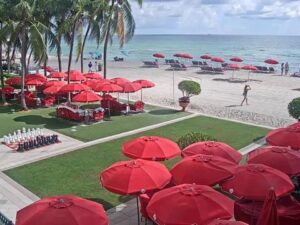


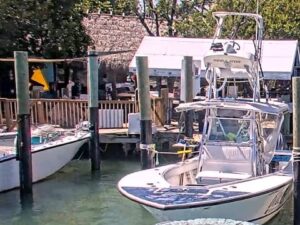

Green Parrot Bar, Whitehead Street, Key West, FL, USA
26.8°C / 80.2°F
13:59

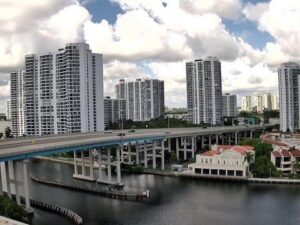

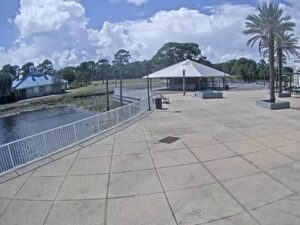
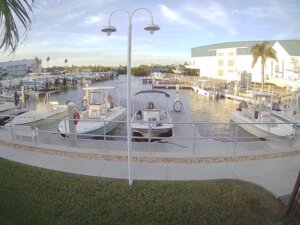
The Hillsboro Inlet Lighthouse Webcam looks south from the gallery of a cast iron tower that has stood at the mouth of the Hillsboro Inlet since 1907. The inlet fills the bottom of the frame, its two rock jetties reaching out into the Atlantic with a pale sandbar shifting between them. Past the south jetty the beach runs away toward Pompano Beach, and on a clear day the high rise line of Fort Lauderdale stacks up on the horizon. Boats pass through the cut all day, because this is the working channel between the Intracoastal Waterway and the open ocean. The water changes color hour by hour, from flat gray under a squall to the banded green and blue of the reef edge.
The light stands on the north side of the Hillsboro Inlet, in the town of Hillsboro Beach in Broward County, and marks the northern end of the Florida Reef. Russell Wheel and Foundry Company of Detroit won the contract in 1905 for an octagonal pyramidal cast iron skeleton tower built around a central stair cylinder, 41 meters (136 feet) to the lens room and 45 meters (147 feet) at its highest point. The lower third is painted white and the upper two thirds black, a day mark that reads clearly against the sky. The tower was cast and assembled in Detroit, then taken apart and shipped roughly 4,000 nautical miles by way of the Great Lakes, the Mississippi River and the Gulf of Mexico to Miami, and barged north up the Florida East Coast Canal.
The lens came from Barbier Benard et Turenne of Paris, a second order bivalve Fresnel 2.4 meters (8 feet) in diameter, rated at 550,000 candlepower and bought for no more than $7,250. It was first lit on March 8, 1907, turning above an incandescent oil vapor lamp on a 10 second flash cycle, with Captain Alfred Berghell as head keeper on $800 a year and two assistants under him. That same lens is still in place and still turning, which is rare. It was restored and relit on August 18, 2000, and the modern characteristic is one white flash every 20 seconds with a nominal range of 28 nautical miles (52 kilometers).
Locals call the tower the Big Diamond, after the diamond shaped panes of glass in the lantern room. The light was automated in 1974 and added to the National Register of Historic Places on February 16, 1979. The Coast Guard handed maintenance to the Hillsboro Lighthouse Preservation Society in 2008, and the society runs this camera along with a companion pointed north up the coast. A bronze statue commemorating the Barefoot Mailman, James Ed Hamilton, was raised here in 2012 in place of a concrete and marble sculpture from 1973.
Winter is the settled season. January averages a high of 23.6 C (74 F) and a low of 16.4 C (62 F) with about 83 millimeters (3.3 inches) of rain across the month, and February is the driest at roughly 70 millimeters (2.7 inches). Mornings then give the camera its cleanest air, with the horizon sharp enough to pick out ships well offshore. By April the highs reach 27.8 C (82 F) and the water has turned the harder blue that shows up well on the south view.
Summer flips it. July and August both average highs near 30.8 C (87 F) with overnight lows around 25 C (77 F), and the rain arrives in convective bursts, so the frame can go from bright sun to a gray wall of squall and back inside an hour. September is the wettest month at about 266 millimeters (10.5 inches), ahead of June at 251 millimeters (9.9 inches) and August at 241 millimeters (9.5 inches), and the year totals roughly 1,810 millimeters (71 inches). Atlantic hurricane season runs from June 1 to November 30, and the inlet is worth watching when a system is offshore: the swell stacks against the jetties and the surf line moves up the beach. October eases back to a high of 28.5 C (83 F).
The tower itself is the hardest ticket on this coast. The Hillsboro Lighthouse Preservation Society runs tours on a limited basis, and joining the society is the way in. The town around it is an oddity: Hillsboro Beach is about 4.8 kilometers (3 miles) long and 274 meters (900 feet) across at its widest, with the single ribbon of A1A Scenic Highway running its whole length, a stretch known as the Hillsboro Mile. Hillsboro Inlet Marina sits just inside the cut and is a base for charter boats running out to the Gulf Stream, which passes close inshore here.
South of the inlet, Pompano Beach Pier gives the view back toward the tower that the Hillsboro Inlet Lighthouse Webcam gives in reverse, and the Pompano Beach Aquatics Center is a short drive inland. North of town, Deerfield Beach Pier is the other classic walk out over the water, and Deerfield Island Park, reached by boat, has hiking trails and quiet ground for wildlife watching. Boca Raton is five to ten minutes up the coast and Fort Lauderdale is under half an hour south.
More cameras worth a look once the tide has run through the inlet:
It stands on the north side of the Hillsboro Inlet in Hillsboro Beach, Broward County, Florida, between Pompano Beach to the south and Deerfield Beach to the north. Boca Raton is five to ten minutes up the coast.
The south view takes in the mouth of the inlet, both rock jetties, the sandbar between them and the beach running south toward the Pompano Beach high rises. Boats moving between the Intracoastal Waterway and the Atlantic cross the frame.
Warm all year. January highs average 23.6 C (74 F) and July highs 30.8 C (87 F). Summer and early autumn are wet, with September the heaviest month at around 266 millimeters (10.5 inches).
It measures 41 meters (136 feet) to the lens room and 45 meters (147 feet) at its highest point, among the tallest light towers on the United States east coast.
Yes. The second order bivalve Fresnel lens supplied by Barbier Benard et Turenne of Paris in 1907 is still in the lantern room and still rotating. It was restored and relit on August 18, 2000.
The nickname comes from the glazing. Each pane of glass in the lantern room is cut as a diamond, and the pattern shows in any photograph with enough detail.
Access is limited. The Hillsboro Lighthouse Preservation Society, an all volunteer non profit, runs tours occasionally, and you have to join the society to take one.
The best new live webcams and site features, once a week.
By subscribing you agree to receive our weekly email. Unsubscribe any time.
 23.3°C / 73.9°F
 25.4°C / 77.7°F