
 English
 简体中文
 Deutsch
 Français
 Español
 Nederlands
 Svenska
 Italiano
 日本語
 Polski
 Português
 Русский
 Ελληνικά
 العربية
 Türkçe

Live
 14:07:27
 17.6°C / 63.7°F
 Clear Sky
 60%
 21 km/h / 13 mph
 06:35
 16:46
Loading forecast…

Lake Hopatcong, Jefferson Township, New Jersey, USA
 13.1°C / 55.6°F
14:07

Duke Farms, Dukes Parkway West, Hillsborough Township, NJ, USA
15.6°C / 60.1°F
14:07
Seaside Heights, Barnegat Peninsula, New Jersey, USA
17.7°C / 63.9°F
14:07

Sandy Hook, Monmouth County, New Jersey, USA
17.4°C / 63.3°F
14:07
R Lazy S Ranch, Jackson Hole, Wyoming, USA
10.9°C / 51.6°F
12:07

Sunlight Mountain, Garfield County, Colorado, USA
 5.6°C / 42.1°F
12:07


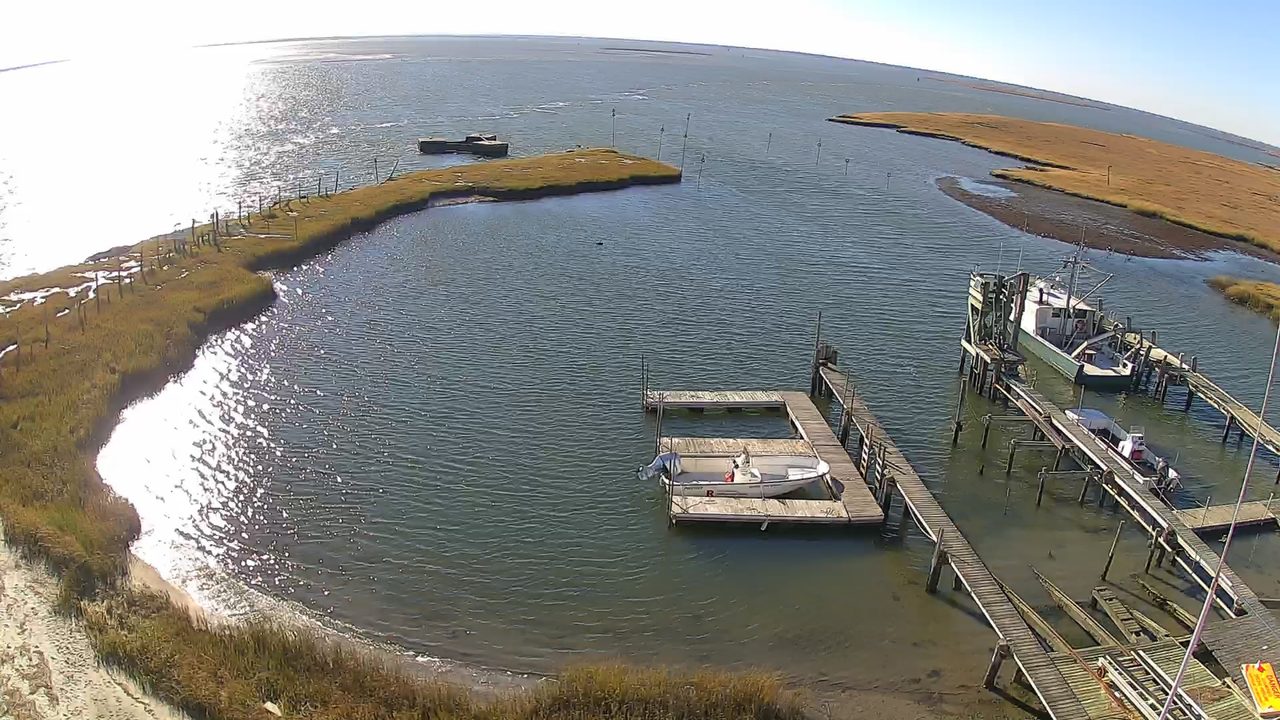
The Rutgers Marine Field Station Webcam looks over the boat basin of Rutgers University’s research station on Great Bay, reached by a single marsh road south of Tuckerton, New Jersey. A wide fisheye lens takes in a floating dock where a small skiff marked with a Rutgers R ties up, a wooden walkway running out to a larger workboat with a raised cabin, and banks of salt marsh curling around the basin. Past the marsh points, the shallow bay runs flat to a horizon the lens bends into an arc, with a line of stakes and a squat concrete block standing out in the water. The tide changes the picture through the day, covering and baring a mudflat at the marsh edge, and on a sunny afternoon the low sun lays a wide band of glare across the left of the frame.
The main building went up in 1937 as a lifeboat station for the U.S. Coast Guard, and Rutgers set up its Marine Field Station there in 1972. Marine scientist Ken Able, who told the building’s story in his book Station 119: From Lifesaving to Marine Research, says the Coast Guard stayed into the 1960s before abandoning this and other stations. Recorded fires struck in 1955, in 1969, when lightning forced a rebuild of the third floor, and in 1976, when flames nearly destroyed the walkway. The facility was renovated in 1995 and now holds flow-through seawater labs, a marine railway and a dive locker.
The station stands at 800 Great Bay Boulevard in Little Egg Harbor Township, about 10.5 kilometers (6.5 miles) south of central Tuckerton in a straight line. Great Bay Boulevard is the only road in, running through the Great Bay Boulevard Wildlife Management Area. Around it spreads the Mullica River-Great Bay estuary: 87 square kilometers (34 square miles) of salt marsh and 56 square kilometers (22 square miles) of shallow water averaging 2 meters (6.6 feet) deep. Rutgers calls it probably the cleanest estuary in the Boston to Washington megalopolis, with only a few populated areas. The station works alongside the Jacques Cousteau National Estuarine Research Reserve, which covers about 115,000 acres (46,500 hectares) of southeastern New Jersey.
Several of the station’s own boats can turn up on the Rutgers Marine Field Station Webcam. Rutgers keeps five small boats of 4.6 to 7.3 meters (15 to 24 feet) for work in the estuary, plus the 9.1-meter (30-foot) R.V. Caleta and the 14.6-meter (48-foot) R.V. Arabella for trips onto the continental shelf. Every week since the late 1980s, staff and students have sampled fish and crab larvae here, a record Rutgers calls the longest time series tracking marine life along the East Coast. The station also passed its Hurricane Sandy data to the National Weather Service in 2012. Rising water is its own subject now: Rutgers notes that the sea is climbing quickly here, partly because the South Jersey coast itself is sinking.
Tuckerton has a humid subtropical climate, with hot, humid summers and mild to cool winters. Over the past decade, July afternoons at the station have averaged about 29°C (84°F), with nights around 22°C (72°F), and August runs only slightly cooler. January is the coldest month, with highs near 6°C (43°F) and lows around -2°C (28°F), so frosty mornings are routine in midwinter. Spring warms steadily, from April highs of about 16°C (61°F) to around 20°C (68°F) in May.
Autumn holds on well, with September highs near 25°C (77°F) and October near 20°C (68°F). By November the marsh grass around the basin has turned gold, highs sit near 14°C (57°F), and the afternoon sun stands low enough to throw glare across the water on the Rutgers Marine Field Station Webcam. Late summer and autumn also carry the storm risk. Hurricane Sandy damaged roughly 4,000 homes in Little Egg Harbor Township in October 2012, and Tropical Storm Irene came ashore at nearby Brigantine in August 2011, a landfall first reported at Little Egg Inlet.
The drive out is part of the visit. Great Bay Boulevard crosses several one-lane wooden bridges with a speed limit of 16 km/h (10 mph), and the view ahead opens into marsh, open water and sky. The Jacques Cousteau reserve’s Jacques Cousteau Coastal Education Center stands on Great Bay Boulevard near its start, about 400 meters (a quarter mile) past the Radio Road intersection. On Radio Road itself, a memorial marks a Revolutionary War night raid in which Ferguson’s troops rowed about 16 kilometers (10 miles) to Osborn Island and surprised an outpost of Pulaski’s men.
In Tuckerton, the Tuckerton Seaport and Baymen’s Museum is a 16-hectare (40-acre) working maritime village on Tuckerton Creek at 120 West Main Street, just off Garden State Parkway Exit 58. It began as the Barnegat Bay Decoy and Baymen’s Museum and now houses the Jersey Shore Folklife Center, and its visitor center holds the Jacques Cousteau reserve’s interpretive center.
More salt marsh, research harbors and South Jersey water:
It is at 800 Great Bay Boulevard in Little Egg Harbor Township, Ocean County, New Jersey, with a Tuckerton mailing address. The station sits on the Mullica River-Great Bay estuary, about 10.5 kilometers (6.5 miles) south of central Tuckerton.
The station’s boat basin: a floating dock with a small Rutgers skiff, a wooden walkway out to a larger workboat, salt marsh banks on both sides and Great Bay running to the horizon. The tide moves the waterline at the marsh edge through the day.
Humid subtropical. July highs average about 29°C (84°F) and January highs about 6°C (43°F), with January nights near -2°C (28°F). Late summer and autumn bring the hurricane risk, as Sandy showed in 2012.
It is a working research facility rather than a public attraction, but it holds open-house events with the Jacques Cousteau National Estuarine Research Reserve. The only road in, Great Bay Boulevard, crosses one-lane wooden bridges with a 16 km/h (10 mph) limit.
Its best-known work is a weekly sampling of fish and crab larvae that has run since the late 1980s, which Rutgers calls the longest time series tracking marine life on the East Coast.
Five small boats of 4.6 to 7.3 meters (15 to 24 feet) work the estuary. Two larger research vessels, the 9.1-meter (30-foot) R.V. Caleta and the 14.6-meter (48-foot) R.V. Arabella, head out onto the continental shelf.
It was built in 1937 as a U.S. Coast Guard lifeboat station. The Coast Guard left in the 1960s, Rutgers took it over in 1972, and the main facility was renovated in 1995.
The best new live webcams and site features, once a week.
By subscribing you agree to receive our weekly email. Unsubscribe any time.
 24.3°C / 75.7°F