 English
 简体中文
 Deutsch
 Français
 Español
 Nederlands
 Svenska
 Italiano
 日本語
 Polski
 Português
 Русский
 Ελληνικά
 العربية
 Türkçe
Live
 17:49:23
 8.1°C / 46.6°F
 Broken Clouds
 49%
 7 km/h / 4 mph
 07:12
 17:29
Loading forecast…
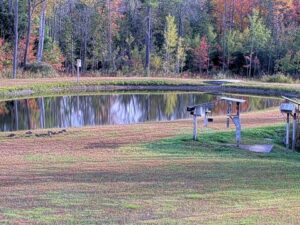
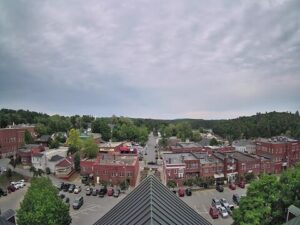
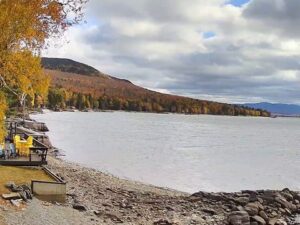
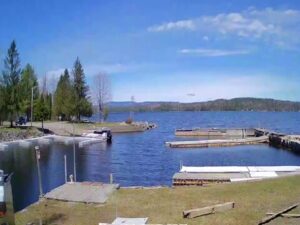
The Hog Island Osprey Webcam looks out from the roof of the Audubon boathouse in Bremen, Maine, over an osprey nest and across a narrow channel to Hog Island in Muscongus Bay. Lobster boats ride on their moorings in the middle distance, white buoys dot the water, and the island’s dark band of conifers fills the far shore. A bare, dead snag rises at the right edge of the frame, with the boathouse dock and a small skiff below it, and the sticks of the nest show along the bottom. In the nesting season the camera is trained on the nest, where ospreys raise their chicks through the summer. Once the family has gone south, the picture opens out over the harbor, so the tide, the boats and the light on the island become the show.
Hog Island covers 330 acres (130 hectares) of Muscongus Bay where Keene Neck Road ends, in the town of Bremen. The island and 30 acres (12 hectares) of mainland facing it make up the Todd Wildlife Sanctuary, and the boathouse under this camera stands on that mainland side. Bremen is a small coastal town of 823 people at the 2020 census, with a total area of 72 square kilometers (27.9 square miles) taking in necks, coves and islands, and the Medomak River estuary marks its eastern border with Friendship. Abenaki people once spent their summers on Keene Neck, gathering shellfish and leaving shell middens behind.
In the late 19th century the island held a summer resort, the Point Breeze Inn and Bungalows. By 1910 Mabel Loomis Todd, the original editor of Emily Dickinson’s poetry, was buying up tracts of Hog Island to save its timber from clearcutting, and she and her husband, the Amherst College astronomer David Peck Todd, built a rustic summer camp there. Their daughter, Millicent Todd Bingham, inherited the island in 1932 and worked with the National Audubon Society to set up a nature study camp at the old Point Breeze site. The Audubon Nature Camp opened in the summer of 1936, and Roger Tory Peterson, author of the Peterson field guides, was among its staff.
In the 1970s Stephen Kress, an ornithology instructor at the camp, founded Project Puffin, the program that brought puffins and terns back to their historic nesting islands on the Maine coast. The boathouse nest has a shorter story. A young pair took it over in 2016 but gave up after two seasons, and in 2021 a pair named Dory and Skiff produced no viable eggs. In 2022 the nest fledged chicks for the first time, three of them, named Schooner, Skipjack and Sloop. Each year the family leaves in early September and flies south through the Caribbean to South America, one of the long autumn journeys of the kind traced on our bird migration map.
Muscongus Bay has a cool coastal climate with four distinct seasons. January and February afternoons average about 1°C (34°F), nights fall well below freezing, and snow can settle on the dock and the island’s trees. Spring comes slowly to this water: April afternoons average about 11°C (51°F) and May about 17°C (63°F), and the nesting season runs from spring into late summer.
Summer is mild, with July and August afternoons around 25 to 26°C (77 to 79°F). September stays warm at about 22°C (71°F) while the ospreys leave, and October drops to about 15°C (59°F), when yellow and orange leaves start to show among the conifers along the island’s shore. Rain or snow falls in every month, from about 65 millimeters (2.6 inches) in May to about 136 millimeters (5.4 inches) in October, the wettest month over the last decade.
The island across the channel is the reason most people know this corner of Maine. From late May through September, Audubon’s Seabird Institute runs six-day residential programs on Hog Island in birding, ornithology and natural history, for adults, teens, families and environmental educators.
Along the coast, Pemaquid Point Light in the town of Bristol stands about 17 kilometers (11 miles) south of the camp. To the east, the village of Friendship sits across the Medomak River estuary, and Rockland, about 28 kilometers (17 miles) to the northeast, is home to the Farnsworth Art Museum and the Rockland Breakwater Lighthouse. Marshall Point Lighthouse at Port Clyde has a webcam of its own on this site.
More ospreys and more of the Maine coast:
On the mainland in Bremen, Lincoln County, on Maine’s midcoast. The camera sits on top of the Audubon boathouse in the Todd Wildlife Sanctuary, where Keene Neck Road ends, and faces Hog Island across a narrow channel in Muscongus Bay.
An osprey nest in the foreground, a mooring field of lobster boats and buoys, and the wooded shore of Hog Island across the water. A dead snag stands at the right edge, with the boathouse dock below it. In the nesting season the camera is trained on the nest; outside it, the view opens out over the harbor and the island.
No. The camera is in Bremen, about 28 kilometers (17 miles) southwest of Rockland, so Rockland Harbor, its ferry terminal and the breakwater are all out of view. What it shows is the channel between Keene Neck and Hog Island.
No. This is an osprey nest on a sheltered mainland shore, and puffins nest on offshore islands. Hog Island’s tie to puffins is its history: Stephen Kress, an ornithology instructor at the camp in the 1970s, founded Project Puffin, which returned puffins and terns to their old nesting islands along the Maine coast.
In early September, when the family heads south through the Caribbean to South America for the winter. The nest then stays empty until the next nesting season. The first chicks to fledge from it were three in 2022.
Cool and coastal. Afternoons average about 1°C (34°F) in January, about 25°C (77°F) in July and August, and about 15°C (59°F) in October, the wettest month of the last decade. Snow is likely in the depth of winter.
The camp runs six-day residential programs on the island from late May through September, for adults, teens, families and environmental educators, covering birding, ornithology and natural history. Audubon’s Seabird Institute operates it, and session details are on the camp’s own website.
Source: Explore Osprey & Peregrine Falcon Cams and Hog Island Audubon Camp
The best new live webcams and site features, once a week.
By subscribing you agree to receive our weekly email. Unsubscribe any time.
 9.6°C / 49.3°F



 2.9°C / 37.2°F