Live

 22:46:10
 -0.3°C / 31.5°F
 Overcast Clouds
 81%
81% 5 km/h / 3 mph
 08:19
08:19 18:23
18:23Loading forecast…
The Alberta Bird Feeder Webcam watches a backyard feeding station in the foothills of southern Alberta, run by the channel Canadian Bird Nerd. The main camera looks past three hanging feeders to a mown lawn, a paved path, a field of tall golden grass and a row of rooftops, with the Rockies a pale line on the horizon behind them. A second camera sits closer to a pole of finch feeders in front of a tree with dark red and purple leaves. Both stream around the clock, all year, and the yard turns with the seasons: green lawn in summer, gold grass in autumn and snow in winter, when common redpolls can drop in from the north.
Canadian Bird Nerd describes its cameras as set in southern Alberta near Banff National Park, at the foot of the Rocky Mountains. The exact address is not published, which is normal for a camera in a private yard, so the map pin on this page marks the region rather than the house. The scenery matches the description: open grassland and the edge of a residential area in front, mountains far behind. Banff National Park was established in 1885 as Canada’s first national park, covers 6,641 square kilometers (2,564 square miles) and lies about 128 kilometers (80 miles) by road from Calgary, the region’s largest city, which sits at 1,084 meters (3,557 feet) above sea level.
The mountain view camera, the first tab on this page, has been running on its current broadcast since December 2024. Two tube feeders with wide clear domes hang either side of a caged suet feeder, and behind them the lawn, the path and the grass field fill the middle of the frame. A clock and a small temperature readout sit in the top corners of the picture. The finch feeder camera, live since May 2026, is the closer view: two mesh feeders and two clear seed tubes with perches on a metal pole, with a chain-link fence and green shrubs behind the leaves. The operator’s website lists Axis network cameras paired with Axis microphones, so the streams carry sound as well as picture.
Clips on the channel name the regulars. Downy and hairy woodpeckers share the suet with northern flickers, black-capped chickadees have raised a family in one of the operator’s nest boxes, and house finches and American goldfinches arrive in small flocks. Rarer visits get clips of their own, such as a rose-breasted grosbeak and common redpolls that the operator calls rare winter visitors. Deer also wander through the yard. On the October morning this page was written, a northern flicker clung to one of the finch feeders, its barred brown back lit by the low sun.
Calgary’s long-term averages are the closest published guide for this part of the foothills. January averages -7.6 C (18 F), with daytime highs near -1.5 C (29 F) and nights around -13.5 C (8 F). July averages 16.9 C (62 F), with afternoons near 23.5 C (74 F) and nights around 10.2 C (50 F). Snowfall adds up to about 139 centimeters (55 inches) a year, but total precipitation is only about 445 millimeters (17.5 inches), and June is the wettest month with 113 millimeters (4.4 inches).
Winter here is not one long freeze. Chinook winds coming down the eastern slopes of the Rockies can lift temperatures by 20 C (36 F), and sometimes by as much as 30 C (54 F), within a few hours, and the warm spell can last several days. Calgary records about 2,396 hours of sunshine a year, so blue skies behind the feeders are common in every season. Autumn turns the grass field gold, as it was in early October 2026.
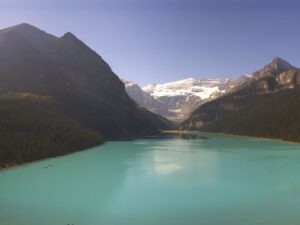
Banff National Park is the obvious trip west. Lake Louise sits below the Victoria Glacier and is one of the most visited lakes in the world, and Moraine Lake, 15 kilometers (9.3 miles) away, looks across the Valley of the Ten Peaks. North of Lake Louise, the Icefields Parkway runs 230 kilometers (143 miles) to Jasper, with around 100 glaciers visible from the road.
For birders, two places closer to Calgary are worth the drive. Inglewood Bird Sanctuary is a 36-hectare (89-acre) reserve on the Bow River, 5 kilometers (3.1 miles) east of downtown, where more than 270 bird species have been recorded in its riverside forest and around a central lagoon. Farther south, Frank Lake Conservation Area, a restored wetland just southeast of High River, has logged 194 bird species and is considered the most important wetland in southwestern Alberta for breeding water birds, with trumpeter swans, American white pelicans and American avocets among its draws. Over the open grassland of southern Alberta, Swainson’s hawks hunt from spring to late summer before setting off for the pampas of Argentina, about 10,000 kilometers (6,200 miles) away, one of the longest raptor journeys on our bird migration map.
More cameras from Alberta, and another feeder station far to the south:
In a private backyard in the foothills of southern Alberta, Canada, which the operator places near Banff National Park. The exact site is not published, so the map shows the region. Calgary is the main city in the area, and Banff National Park is about 128 kilometers (80 miles) from Calgary by road.
The main view shows three feeders in front of a lawn, a path, a golden grass field and distant rooftops, with the Rockies faint on the horizon. The second tab is a close view of finch feeders on a pole in front of a red-leaved tree.
The channel’s clips show downy and hairy woodpeckers, northern flickers, black-capped chickadees, house finches, American goldfinches, white-breasted nuthatches and several sparrows, including white-crowned and savannah sparrows. Common redpolls appear in winter, and rose-breasted grosbeaks and yellow-headed blackbirds have made rarer visits.
Cold, sunny winters broken by chinook thaws, and warm summers with a wet June. Calgary averages -7.6 C (18 F) in January and 16.9 C (62 F) in July, with about 139 centimeters (55 inches) of snow a year.
Yes. The operator describes the cameras as year-round streams that capture daytime activity and nocturnal moments, so the player keeps running after dark. Feeder birds come by in daylight, so mornings and afternoons on Mountain Time are the best hours to look.
The Mountain View Feeder camera is the wide one, with the lawn, the grass field and the mountains behind its three feeders. The Finch Feeder camera sits closer to a pole of seed tubes and mesh feeders, so small birds fill more of the frame. Switch between them with the tabs on the player.
Canadian Bird Nerd, a YouTube channel that joined the platform in 2019. Alongside the two live streams it posts clips of notable visits, from nesting chickadees to winter redpolls.
Source: Canadian Bird Nerd
The best new live webcams and site features, once a week.
By subscribing you agree to receive our weekly email. Unsubscribe any time.

 0.2°C / 32.4°F

 4.7°C / 40.5°F
 6.2°C / 43.2°F