
 English
 简体中文
 Deutsch
 Français
 Español
 Nederlands
 Svenska
 Italiano
 日本語
 Polski
 Português
 Русский
 Ελληνικά
 العربية
 Türkçe

Live
 00:18:44
 16.8°C / 62.2°F
 Clear Sky
 52%
 11 km/h / 7 mph
 06:01
 16:47
Loading forecast…
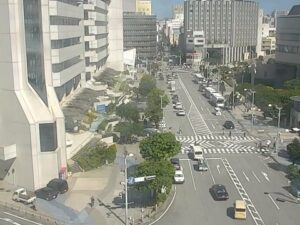
The Shinjuku Webcam looks down on the busy junction outside Seibu-Shinjuku Station in Tokyo, where Yasukuni Street meets the long JR rail bridge known as the Shinjuku O-Gado. The Yunika Vision screens wrap around a round glass building on the left, the tracks sweep across the upper right, and the PePe plaza fills the bottom of the frame with people gathering or heading for the station. Green-striped Yamanote Line trains and orange-striped Chuo Line trains cross the bridge, sometimes side by side. The stream runs 24 hours a day, so the picture moves from bright daytime traffic to neon, headlights and glowing screens after dark. A small clock in the top corner shows Japan time.
Shinjuku is one of the special wards of Tokyo, and this corner sits where its east side meets the railway. The camera looks roughly south-west from above the plaza. The rail bridge in the middle of the frame is the O-Gado, which carries Yamanote, Chuo and Shonan-Shinjuku line tracks over the road, with Saikyo Line tracks running alongside just north of it. Those lines feed Shinjuku Station, which opened in 1885 and which Guinness World Records lists as the busiest railway station in the world, with about 3.59 million passengers a day in 2018. On the far side of the tracks you can pick out the billboards and karaoke signs of the west side.
The round building on the left carries Yunika Vision, one of the largest outdoor street screens in Japan. It has three LED screens of 100 square meters (1,076 square feet), linked so that one picture can run across all of them, and a speaker system loud enough to reach the street. Riders on JR trains crossing the O-Gado can see it from their windows. Yamada Denki’s Labi store in the same building closed on October 14, 2020, but the screens carried on, and in October 2026 they were showing full-length Ado concert footage. The area also appears in the 2018 film Inuyashiki, which used Yunika Vision and the PePe plaza as a location.
Seibu-Shinjuku Station, just behind the camera’s view, has its own odd story. It opened in March 1952 as a temporary terminus, with a plan to extend the Seibu Shinjuku Line to the main station. That extension never came, and the line still stops about 400 meters (1,312 feet) short. The present 25-story complex, finished in 1977, stacks the station, the Shinjuku Prince Hotel and the PePe shopping center into one block.
Central Tokyo has a humid subtropical climate, with figures here from the 1991 to 2020 normals at Kitanomaru Park. January runs from 1.2°C to 9.8°C (34°F to 50°F). Snow is sporadic, with an annual total of about 8 centimeters (3.1 inches), so a white plaza is a rare sight on this camera. April warms to between 9.8°C and 19.4°C (50°F and 67°F).
August is the peak of the heat at 23.5°C to 31.3°C (74°F to 88°F), and October eases back to 14.8°C to 22.0°C (59°F to 72°F). Tokyo gets about 1,598 millimeters (62.9 inches) of rain and snow a year, and typhoons reach the city in most years, though few are strong. On clear late October afternoons, the low sun can wash across the lens for a while around 2:30 PM, and in the morning part of the junction sits in shade. After dark the tracks fade almost to black, and the screens and the west side signs take over the picture.
Kabukicho starts right beside the plaza. Its Ichibangai street is only a short walk east, and Tokyu Kabukicho Tower stands just north of the station with 109 Cinemas Premium Shinjuku, Zepp Shinjuku, Theater Milano-Za and a namco arcade under one roof. Cross under the O-Gado to the west side and you reach Omoide Yokocho, a narrow lane beside the tracks with more than 70 tiny izakaya.
Further east, Hanazono Shrine is under 500 meters (1,640 feet) from the crossing. Entry is free and a flea market runs on Sundays. Shinjuku Golden Gai sits right next to the shrine, a warren of ramshackle wooden buildings holding roughly 200 small bars. For open space, Shinjuku Gyoen National Garden lies just over 1 kilometer (0.6 miles) to the south-east, a green break from the streets you see on the camera.
These cameras show other sides of Tokyo, from neon alleys to its most famous crossing.
Shinjuku is a special ward in central Tokyo, Japan. This camera covers the junction beside Seibu-Shinjuku Station and the PePe plaza, at the Shinjuku O-Gado rail bridge on Yasukuni Street.
The frame takes in the road junction, the PePe plaza, the JR tracks on the O-Gado bridge and the Yunika Vision screens, with the billboards of the west side behind them.
Summers are hot and humid, with August highs near 31.3°C (88°F). Winters are cool, with January lows near 1.2°C (34°F) and only occasional snow.
JR commuter trains cross the bridge, including the green-striped Yamanote Line and the orange-striped Chuo Line. The Shonan-Shinjuku and Saikyo lines also use these tracks. Seibu trains stay out of sight, because their station is behind the camera’s view.
Yunika Vision is a set of three large LED screens on the Yunika Building, facing Yasukuni Street and Seibu-Shinjuku Station. It shows music programs, live broadcasts and film and game promotions.
Its published hours are 7:00 AM to 1:00 AM Japan time, according to an August 2026 program notice, so the screens may be dark in the small hours even though the camera keeps running.
The operator describes the stream as carrying the noise of the city, passing trains, the audio from the screens and the melody of the crossing signals.
About 400 meters (1,312 feet). The Seibu line was meant to be extended to the main station after 1952, but the link was never built.
Source: Info Shinjuku Channel
The best new live webcams and site features, once a week.
By subscribing you agree to receive our weekly email. Unsubscribe any time.
 2.3°C / 36.1°F


 7.5°C / 45.5°F

