Live
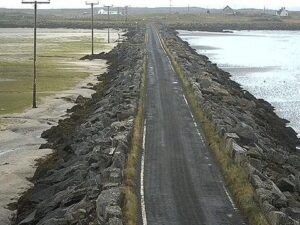
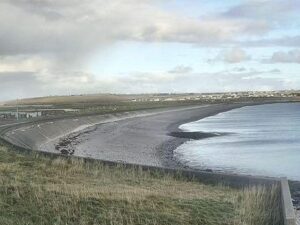
Baleshare Causeway, North Uist, Scotland
Baleshare, North Uist, Outer Hebrides, Scotland
 8°C / 46.4°F
 01:35
01:35 01:35:19
 9°C / 48.2°FOvercast Clouds
 87%
87% 6 km/h / 4 mph
 07:58
07:58 17:51
17:51Loading forecast…
The Bass Rock Webcam streams from a 360 degree camera on the Bass Rock, the steep-sided island off North Berwick in East Lothian that holds one of the largest northern gannet colonies on the planet. Gannets cover the slopes in the foreground almost shoulder to shoulder, the domed summit rises on the right, and open water runs out to a low line of distant coast on the left. Overhead, birds wheel against the sky. The Scottish Seabird Centre runs the camera and sends the picture across the water to its visitor center on North Berwick harbor. The scene changes hard with the seasons: crowded and restless from spring into autumn, far emptier once the gannets leave at the end of October.
The Bass Rock rises 107 meters (351 feet) out of the outer Firth of Forth, about 2 kilometers (1.2 miles) offshore and 5 kilometers (3 miles) northeast of North Berwick. The whole island covers only about 3 hectares (7 acres), yet the Scottish Seabird Centre counts as many as 100,000 northern gannets on it at the height of the breeding season and describes it as the largest colony of the species in the world. The bird’s scientific name, Morus bassanus, is taken from the rock. Gannets are big, with a wingspan of up to 2 meters (6.6 feet), and they feed by diving headfirst into the sea at up to 97 km/h (60 mph).
The feed comes from a new system that pairs industrial grade 360 degree 8K cameras with an off-grid solar battery supply, paid for by the Scottish Marine Environmental Enhancement Fund. A high-speed microwave link carries the picture from the lighthouse complex on the island to the mainland. The lighthouse itself dates from 1902 and was designed by David Stevenson, a cousin of Robert Louis Stevenson. People on the path through the colony are usually researchers monitoring the birds, or small groups of photographers on guided summer landings.
The ruins on the island are far older than the lighthouse. A papal bull of 1493 describes St Baldred’s chapel on the rock as newly established. The castle served as a prison from 1671, and 39 Covenanters were held there as religious and political prisoners. On 18 June 1691 four Jacobite officers seized the castle and held it until 18 April 1694. Highly pathogenic avian influenza reached the colony in June 2022, and more than 5,000 dead birds were counted in a single day. In June 2026 RSPB Scotland took ownership of the Bass Rock and neighboring Craigleith from the Dalrymple family, who had held the islands for 320 years.
The Met Office averages for Dunbar, about 11 kilometers (7 miles) southeast along the coast, give a good idea of conditions out on the rock. Between 1991 and 2020, July afternoons averaged about 19 C (66 F) with nights near 12 C (53 F), while January highs sat around 7 C (45 F) and lows around 2 C (36 F). Rain totals about 622 millimeters (24.5 inches) a year. May brings the most sunshine, close to 197 hours, against about 52 hours in December.
On camera, the seasons show through the birds more than the weather. Gannets start arriving in late February, and through spring and summer the slopes fill with nesting pairs and then chicks. By the end of October the birds head for wintering grounds in the southern North Sea, the Mediterranean or West Africa, so a winter view typically shows far emptier slopes and fewer wings in the sky. Some of Scotland’s other seabirds go much farther: Manx shearwaters from the Hebrides cross the Atlantic to spend the winter off Brazil and Argentina, a route on our bird migration map. Daylight swings widely at this latitude, from about 17 hours 40 minutes around the June solstice to under 7 hours in late December.
The Scottish Seabird Centre stands on North Berwick harbor and opened in 2000. Its Discovery Experience shows the live Bass Rock panorama in higher definition than the online stream. From late March to early October the center runs wildlife boat trips from the harbor. The Three Islands Seabird Seafari takes 1 hour 15 minutes by rigid inflatable boat around the Lamb, Craigleith and the Bass Rock. The Seabird Catamaran Cruise circles Craigleith and the rock on a 55-seat catamaran from April to September, and the Isle of May Round Island Trip runs about two hours from April to July. For a closer look, the Bass Rock Experience lands small guided groups, aged 16 and over, on the rock itself.
Ashore, North Berwick Law is a 187 meter (613 foot) volcanic hill rising above the town. Tantallon Castle stands on the coast 5 kilometers (3 miles) east of North Berwick, directly across the water from the rock. The town has two sandy bays, East or Milsey Bay and West Bay, and Seacliff beach lies a short way east. North Berwick itself, home to about 7,840 people, is 32 kilometers (20 miles) east-northeast of Edinburgh.
More bird and coast cameras, two of them in Scotland:
The Bass Rock is an island in the outer Firth of Forth off East Lothian, Scotland, about 2 kilometers (1.2 miles) offshore and 5 kilometers (3 miles) northeast of North Berwick.
A wide 360 degree panorama from the island itself: gannets packed across the slopes, the summit of the rock, open sea, a distant strip of coast and birds in flight overhead.
Northern gannets begin arriving in late February and stay through the breeding season, leaving at the end of October for the southern North Sea, the Mediterranean or West Africa.
The Scottish Seabird Centre puts the colony at as many as 100,000 northern gannets at the height of summer, which it describes as the largest northern gannet colony in the world.
Cool for most of the year. Met Office averages for nearby Dunbar give July highs of about 19 C (66 F) and January highs of about 7 C (45 F), with roughly 622 millimeters (24.5 inches) of rain a year.
Yes, on a guided trip. The Scottish Seabird Centre’s Bass Rock Experience lands small groups aged 16 and over, and its boat trips from North Berwick harbor circle the rock between late March and early October.
RSPB Scotland has owned the Bass Rock since June 2026, when it acquired the island and neighboring Craigleith from the Dalrymple family. The family had held them for 320 years, and the islands are now in charitable ownership for the first time.
The Discovery Experience at the Scottish Seabird Centre in North Berwick shows the live Bass Rock panorama in higher definition than the YouTube stream.
Source: Scottish Seabird Centre
The best new live webcams and site features, once a week.
By subscribing you agree to receive our weekly email. Unsubscribe any time.


 6.1°C / 43°F


 2.1°C / 35.8°F
 2.9°C / 37.2°F