Live
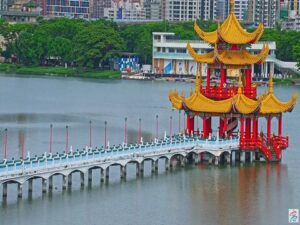
Lotus Pond, Kaohsiung, Taiwan
Lotus Pond, Zuoying District, Kaohsiung City, Taiwan
 25.9°C / 78.6°F
 03:01
03:01 03:01:11
 22.4°C / 72.3°F
 Clear Sky
 75%
75% 11 km/h / 7 mph
 05:52
05:52 17:29
17:29Loading forecast…
Lotus Pond, Zuoying District, Kaohsiung City, Taiwan
25.9°C / 78.6°F
03:01

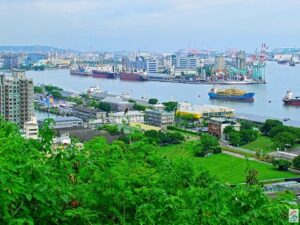
Shoushan LOVE Lookout, Zhongyi Road, Gushan District, Kaohsiung City, Taiwan
25.8°C / 78.4°F
03:01


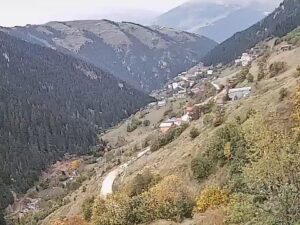

Hotel Annapurna View Sarangkot Pvt. Ltd., Pokhara, Nepal
16.4°C / 61.5°F
00:46
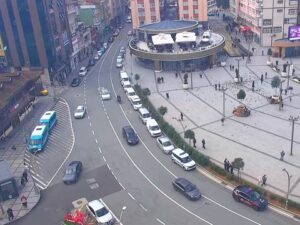

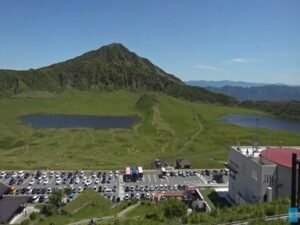
Kusasenri Observatory, 1662-9 Nagakusa, Aso, Kumamoto, Japan
 13°C / 55.4°F
04:01
13°C / 55.4°F
04:01

The Daxi Old Street Webcam is a pan-tilt-zoom camera at the western end of Heping Road in Daxi District, Taoyuan, Taiwan, on the corner where Puji Road joins the old street. Its main view runs east-southeast down Heping Road, past the curved red gable of a temple building in the right foreground, between rows of old shophouses to green hills at the far end. On its tour the camera also swings along Puji Road to the ornate gateway of Puji Temple, and down into a temple forecourt with a paper-burning furnace and clipped hedges. On a weekday afternoon the street carries a steady mix of scooters, delivery vans and people on foot. On busy days the same stretch fills wall to wall with people, as the operator’s own still from this camera shows.
Daxi Old Street is the collective name for the historic shopping streets of Daxi: Heping Road, Zhongshan Road and Zhongyang Road, with Heping Road at the center. The camera stands at Heping Road’s western end, and the street runs roughly 400 meters (1,300 feet) from there. Taoyuan’s tourism office notes that Heping Road was developed later than its neighbors, so its old houses are among the best preserved. Their facades went up in the Taisho era of Japanese rule, when Baroque styling was in fashion, and they mix Baroque ornament with southern Fujian (Min-nan) motifs: Greek-style pediments and Roman columns sit beside carved fish and bats, both symbols of good fortune.
Daxi was the first part of Taoyuan to develop. Its older name, Dakekan, comes from Takoham, the Atayal name for the river, and the Japanese administration renamed the town Daxi in 1920. Small sailboats carried goods down the Dahan River to the Tamsui River, and trade with mainland China made the town’s merchant families wealthy. That trade faded after the north-south railway, which bypassed the town, opened in the early 1900s. Daxi District now covers 105.1 square kilometers (40.6 square miles) and had 94,475 residents in February 2023.
Puji Temple, about 50 meters (165 feet) north-east of the camera, hosts the biggest event in Daxi’s year. For the birthday of Guan Sheng Dijun (Guan Gong) on the 24th day of the sixth lunar month, residents hold a two-day procession that locals call a second Lunar New Year, with Beiguan music troupes, child performers, temple generals, and dragon and lion dancers. The route runs from Puji Temple along Puji Road, Zhongzheng Road, Zhongyang Road and Heping Road to Fu Ren Temple, so both streets on this camera’s tour are part of it. The celebration dates back to 1917, and in 2011 it was registered as an important intangible cultural asset of Taoyuan City.
Winters in Daxi are mild and often overcast. Average highs from December to February sit around 19 to 20 C (65 to 67 F), with lows of 13 to 15 C (55 to 58 F). Spring warms quickly, to average highs of 22 C (72 F) in March and 25 C (78 F) in April, and rain builds into May and June, the wettest stretch of the year, with the seasonal plum rains.
Summer is hot and humid. July averages a high of 32.5 C (90.5 F) and a low near 25 C (77 F), and the season brings typhoons: storm damage has forced Daxi Bridge, at the river end of town, to be rebuilt twice. Autumn cools gradually, with average highs of about 27 C (80 F) in October and 24 C (76 F) in November, and November is usually one of the driest months. On grey days, which come in every season, the red temple walls in the foreground are the brightest thing in frame.
Daxi Bridge sits at the river end of the old town, below Zhongzheng Park. The 330-meter (1,083-foot) suspension footbridge crosses the Dahan River on 13 abutments and carries only pedestrians and cyclists, linking Daxi Old Street with Rui’an Road Section 1 and the cycle path along the river’s left bank. Its entrance arch follows the same Baroque style as the old street, and its cable lights come on at night. The first bridge on the site dates from 1934. Back in town, the tourism office points visitors to the Daxi Wude Hall, a Japanese-era martial arts hall, the Daxi Wood Art Ecomuseum and the Li Tengfang Mansion.
Food is the other reason people come. Daxi dried tofu is the town’s best-known product and a common ingredient across Taiwanese cooking, and the district holds a Daxi Dried Tofu Festival. The tourism office also recommends the moonlight cakes, peanut candy, douhua (soft tofu pudding in syrup), wa-gui (steamed bowl rice cakes) and tangyuan sold along the old street. Within the wider district are the Cihu Mausoleum and Shimen Reservoir.
These three cameras stay in northern Taiwan.
Daxi Old Street is in Daxi District, Taoyuan City, in northern Taiwan, on the old town’s terrace above the Dahan River. It lies about 29 kilometers (18 miles) southwest of Taipei Main Station in a straight line.
The camera moves between several views. The main one looks east-southeast down Heping Road between old shophouses to hills at the far end, with a temple’s red gable in the foreground. Others look along Puji Road to the gateway of Puji Temple, at the street corner where signs point to Puji Road and Heping Road, and down into a temple forecourt beside a side road.
Not from the main camera, which stays on Heping Road, Puji Road and the temples beside them. The Daxi Bridge tab on the player carries the operator’s camera at the bridge, looking along the deck and its white towers to the wooded far bank.
Mild in winter and hot in summer. Average highs run from about 19 C (66 F) in January to 32.5 C (90.5 F) in July, and the heaviest rain usually falls in May and June.
Dried tofu above all, the town’s signature product, with its own festival in the district. Moonlight cakes, peanut candy, douhua, wa-gui and tangyuan are the other local specialties.
About 22 kilometers (14 miles) in a straight line. Both sit within Taoyuan City: the airport is in Dayuan District on the coast, and Daxi lies south-southeast of it, inland on the Dahan River.
Daxi grew rich as a river port, shipping goods down the Dahan and Tamsui rivers to trade with mainland China. Its Baroque shopfronts date from the Taisho era of Japanese rule, and the town took the name Daxi in 1920.
Source: Taoyuan Travel
The best new live webcams and site features, once a week.
By subscribing you agree to receive our weekly email. Unsubscribe any time.
 16.4°C / 61.5°F