
Live

 02:06:02
 10.4°C / 50.7°F
 Overcast Clouds
 89%
89% 11 km/h / 7 mph
 06:56
06:56 19:52
19:52Loading forecast…


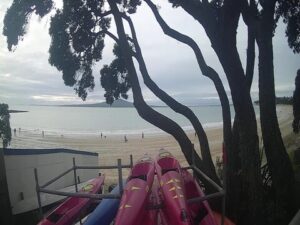
Takapuna Boating Club Inc The Strand, Takapuna, Auckland, New Zealand
 11.6°C / 52.9°F
02:06
11.6°C / 52.9°F
02:06
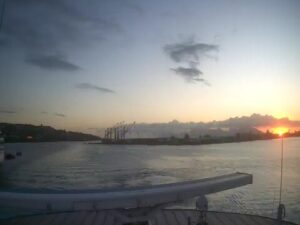
Ferry Terminal Taxi Stand, Papeete, French Polynesia
 24°C / 75.2°F
03:06
24°C / 75.2°F
03:06


Blue Cow (Blue Cow Mountain), Perisher Valley NSW, Australia
 -1.1°C / 30°F
00:06
-1.1°C / 30°F
00:06
Plage de la Baie des Citrons, Nouméa, New Caledonia
21.1°C / 70°F
00:06
Fa'a'ā International Airport, Fa'a'ā, French Polynesia
23.7°C / 74.7°F
03:06The Royal Albatross Webcam streams from Pukekura, also known as Taiaroa Head, the grassy headland at the tip of the Otago Peninsula near Dunedin, where northern royal albatrosses nest on the New Zealand mainland. During the breeding season the camera, known as Royal Cam, stays on a single nest around the clock, so you can follow one pair from the egg in November to the chick’s first flight the following September. Between seasons the camera turns to the headland itself. A slope of rough grass fills the foreground, and beyond it the mouth of Otago Harbour opens toward the Aramoana Mole and the hills running north along the coast. From the September fledging until the new eggs in November there is no nest in view, and the camera goes back to a nest once the new season is under way.
Taiaroa Head sits at the end of the Otago Peninsula, inside Dunedin’s city limits, with the settlement of Otakou about 3 kilometers (1.9 miles) to the south. It guards the mouth of Otago Harbour. Across the channel, the Aramoana Mole runs out for 1,200 meters (3,937 feet) from Aramoana, and it is the long, low line of rock that crosses the frame when the camera looks toward the harbour entrance. The headland’s history is layered: Pukekura pa, a Maori fortified village established about 1650 and still occupied in the 1840s, a lighthouse built in 1864, and Fort Taiaroa, where a restored Armstrong disappearing gun emplacement dates from 1886.
The first albatross egg on the headland was found in 1919, and the first chick fledged in 1938. Today the colony holds an estimated 70 breeding pairs. That is small next to the Chatham Islands, home to around 5,500 pairs, but Taiaroa Head is the only place in the world where northern royal albatrosses breed on a mainland. The 5.3 hectare (13 acre) reserve is managed by the Department of Conservation and supported by the Royal Albatross Centre, which the Otago Peninsula Trust owns and runs.
The Department of Conservation set up Royal Cam in January 2016, and the Cornell Lab of Ornithology has worked on the stream with it since 2019. A pair breeds every two years and lays a single egg in the first three weeks of November. Incubation takes about 80 days, chicks hatch from late January to early February, and they need around eight months before they fledge in September. In the 2025-26 season the camera watched WYL, an 11-year-old male, and BOK, a 12-year-old female, both named for the colours of their leg bands. Their egg was laid on November 6, 2025, and their chick, Awheo, hatched on January 22, 2026.
Dunedin’s long-term averages give a fair guide, although the headland is far more exposed to the open sea than the city. January, the warmest month, averages highs of 18.9 C (66 F) and lows of 11.6 C (53 F). By July the highs fall to 10.4 C (51 F) and the lows to 3.0 C (37 F). Spring and autumn sit close together: October averages 14.9 C (59 F) by day and 7.0 C (45 F) at night, and April 15.4 C (60 F) and 8.2 C (47 F). The city records about 724 millimeters (28.5 inches) of rain and roughly 1,775 hours of sunshine a year, and snow is uncommon outside the inland hill suburbs.
The prevailing wind is a cool southwesterly, which alternates with northeasterlies in late spring, and warm, dry northwesterlies blow through from time to time. On camera, the seasons follow the birds as much as the calendar, from eggs in November to a chick that grows through autumn and winter and leaves in early spring. Under an overcast sky the harbour turns a flat grey, so the clearer days show the coastline best.
The Royal Albatross Centre on the headland is the obvious first stop. It runs guided tours that include the Albatross Classic, Unique Taiaroa and a Fort Taiaroa tour of the 1886 gun emplacement. The headland is also home to the largest little penguin colony left on the Otago Peninsula, and yellow-eyed penguins breed along this stretch of coast. New Zealand fur seals and Hooker’s sea lions are found here too, and dusky dolphins, orcas and whales are sometimes seen offshore.
A short way back along the peninsula, Penguin Place protects yellow-eyed penguins, or hoiho, the largest penguin species that breeds on the New Zealand mainland. The reserve began in 1985, when local farmer Howard McGrouther fenced off land for the eight breeding pairs nesting on his property. Larnach Castle, the 19th-century home of politician and merchant William Larnach, stands on the same peninsula, on the way back toward Dunedin.
If the albatross colony has you looking for more seabirds and southern coastline, these cams are a good next stop.
At Pukekura, also called Taiaroa Head, on the tip of the Otago Peninsula on the southeast coast of New Zealand’s South Island. The headland lies within Dunedin’s city limits and overlooks the mouth of Otago Harbour.
During the breeding season, a single northern royal albatross nest, watched 24 hours a day from the egg to the chick’s first flight. Between seasons, the camera looks across the grass slope to the harbour entrance, the Aramoana Mole and the coast to the north. A caption bar along the top shows the local date and time.
Royal Cam follows a nest only during the breeding season. Chicks fledge in September and the next eggs are laid in the first three weeks of November, so for several weeks in between there is no active nest to watch and the camera shows the headland and harbour instead. The nest view returns once the new season is under way.
Eggs are incubated for about 80 days, so chicks hatch from late January to early February and fledge in September, around eight months later. The 2025-26 chick, Awheo, hatched on January 22, 2026.
Its wingspan reaches 3 meters (9.8 feet). The birds spend at least 85 percent of their lives at sea, feed on squid and octopus near the surface, and fly an estimated 190,000 kilometers (118,000 miles) a year. The species is classed as Threatened, Nationally Vulnerable.
Mild and changeable. Dunedin averages highs of 18.9 C (66 F) in January and 10.4 C (51 F) in July, and the headland is more exposed to the wind than the city.
Yes. The Royal Albatross Centre on the headland runs guided tours, including the Albatross Classic and Unique Taiaroa, plus a Fort Taiaroa tour.
Source: New Zealand Department of Conservation and Cornell Lab
The best new live webcams and site features, once a week.
By subscribing you agree to receive our weekly email. Unsubscribe any time.