Live

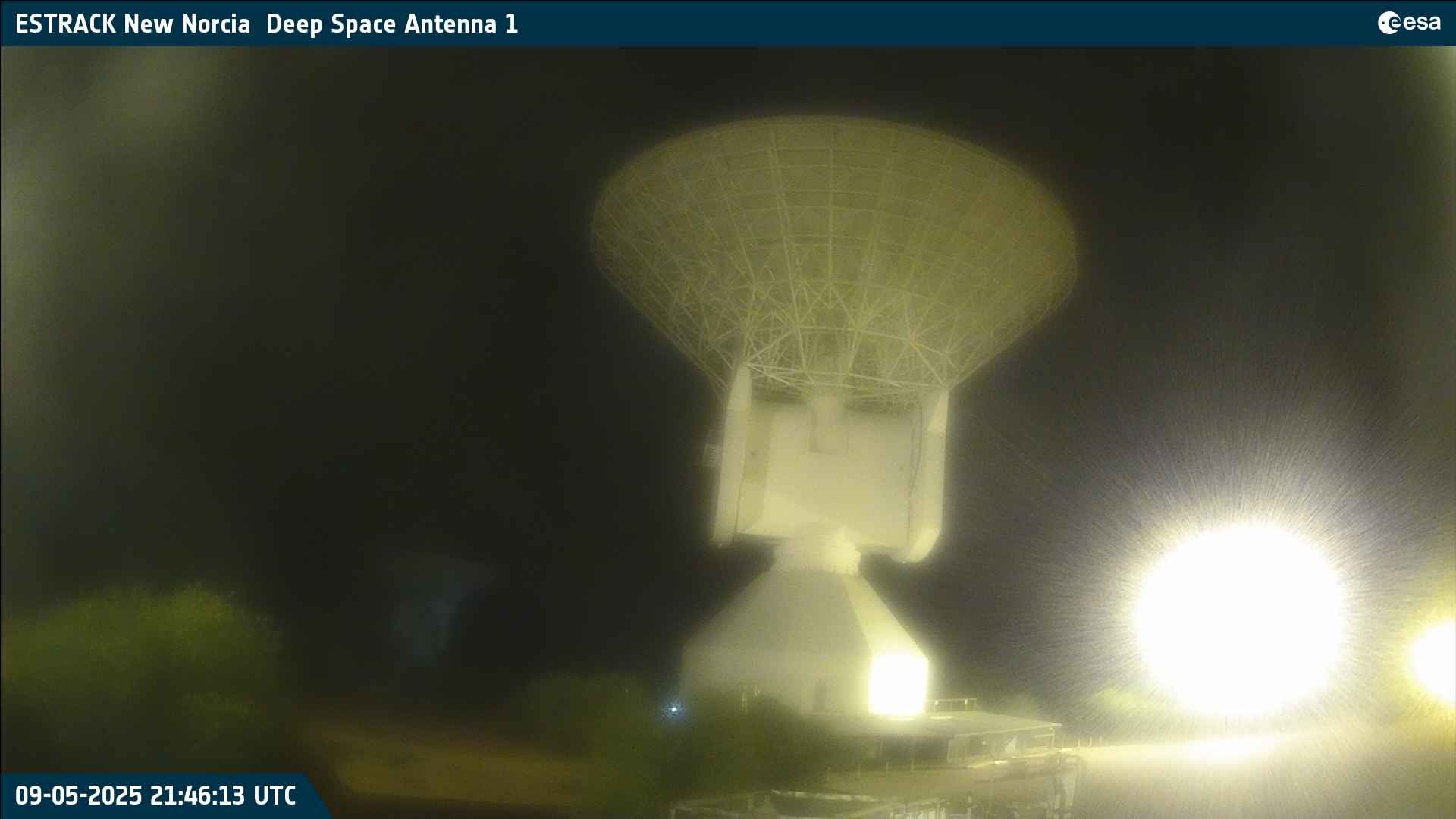
Stream hours: This is a still camera: ESA refreshes the image every few minutes, day and night. After dark in Western Australia the picture is black until sunrise, and the time printed on it is UTC (local time is UTC+8).
 07:14:57
 15.4°C / 59.7°F
 Broken Clouds
 88%
88% 11 km/h / 7 mph
 05:36
05:36 18:25
18:25Loading forecast…



Blue Cow (Blue Cow Mountain), Perisher Valley NSW, Australia
 0.9°C / 33.6°F
10:14
0.9°C / 33.6°F
10:14


Oamaru Blue Penguin Colony Waterfront Road, Oamaru, New Zealand
 9.5°C / 49.1°F
12:14
9.5°C / 49.1°F
12:14
Ferry Terminal Taxi Stand, Papeete, French Polynesia
28°C / 82.4°F
13:14
The New Norcia Webcam looks up at Deep Space Antenna 1, the 35 meter (115 foot) dish at the European Space Agency’s tracking station in rural Western Australia. The white reflector and its concrete pedestal fill the right of the frame, with a low flat-roofed building at the base, eucalyptus trees along the right edge and dry red ground in the foreground. On the left, farmland rolls away to a low horizon, and a second large dish stands further back among the trees. The antenna turns to follow whichever spacecraft it is working with, so its angle can differ each time you check. The camera runs day and night, though after sunset the picture goes dark.
ESA’s New Norcia station sits at an elevation of 252 meters (827 feet), roughly 8 to 10 kilometers (5 to 6 miles) south of the small town that gave it its name, which lies 132 kilometers (82 miles) north of Perth. It belongs to Estrack, the agency’s worldwide network of ground stations, which sends commands to spacecraft and brings back science data and status reports for the European Space Operations Centre in Darmstadt, Germany. Work on the first 35 meter antenna began in April 2000, and the station opened on 5 March 2003. The dish in the foreground stands 40 meters (131 feet) tall, weighs more than 600 tonnes (1.3 million pounds) and works in the S and X bands. Over the years it has supported Mars Express, Rosetta, Gaia and BepiColombo. ESA spaced its three original deep space antennas roughly 120 degrees apart in longitude, here, at Cebreros in Spain and at Malargue in Argentina, so that between them they can stay in touch with an interplanetary probe as the Earth turns.
A much smaller 4.5 meter (15 foot) dish, NNO2, was inaugurated on 11 February 2016 to follow new spacecraft through the first stages of their missions, just after launch. On 4 October 2025 ESA inaugurated a second 35 meter antenna on the site, NNO3, built to work in the X, K and Ka bands. Its first signal came from the Euclid space telescope, and it was due to enter service in 2026 for missions including Juice, Solar Orbiter, BepiColombo, Mars Express, Hera and the ExoMars Trace Gas Orbiter. Since August 2017 a solar farm of 840 panels, rated at 250 kilowatts, has produced about 470 megawatt hours a year, around 40 percent of the station’s electricity.
The town is older than the station by more than 150 years. Spanish Benedictine monks Rosendo Salvado and Giuseppe Serra founded New Norcia in 1847, and it remains Australia’s only monastic town, still home to a Benedictine community. Only 57 people lived there at the 2021 census, and the settlement is listed on the Register of the National Estate.
New Norcia has hot, dry summers and mild, wet winters. From December to February, daytime highs average around 32 to 34 C (90 to 93 F), and nights stay warm at about 17 to 19 C (63 to 66 F). December is usually the driest month of the year, so summer images often show the white dish against a clear sky. Autumn cools steadily: March highs are still near 30 C (86 F), but by May they are down to about 21 C (70 F).
Winter is when the weather turns. June to August highs average about 17 C (63 F), and nights drop to around 8 C (46 F). Most of the area’s roughly 415 millimeters (16 inches) of annual rain falls between May and August, with July the wettest month at around 80 millimeters (3 inches), so overcast days are most likely then. Spring warms quickly, from about 20 C (68 F) in September to 29 C (84 F) by November. Western Australia does not use daylight saving time, so local time stays 8 hours ahead of the UTC timestamp printed on the image all year.
Start at the New Norcia Museum and Art Gallery, which doubles as the visitor center and holds mission and monastery memorabilia, European religious art, contemporary Australian works and a collection of botanical drawings by Charles Austin Gardiner. Guided town tours leave from the museum daily at 11 am and 1:30 pm and take in the historic buildings, including the Abbey Church, where Rosendo Salvado is buried. Visitors can join the monks for prayers in the monastery oratory, held six times a day, and on Saturday afternoons the monastery parlour opens to guests, with the monks sharing stories of the town’s past.
The Salvado Cafe opens daily for light meals and sells goods from the monastery’s wood-fired bakery. For a walk, pick up the River Walk brochure at the museum and follow the trail across the Moore River to the old Apiary Indigenous Artefact Display, then stop at the Mission Cottages Interpretation Centre, which tells the story of the Aboriginal families who lived and worked at New Norcia. Anyone wanting a longer stay can book a retreat in the Monastery Guesthouse, or a silent retreat in the Hermitage.
For more telescopes, launch sites and Australian views, try these cameras.
The station is in Western Australia, roughly 8 to 10 kilometers (5 to 6 miles) south of the town of New Norcia, on the Perth side of town, at 252 meters (827 feet) above sea level.
The camera faces Deep Space Antenna 1, ESA’s first 35 meter (115 foot) dish at the site, with its service building, a paved yard and eucalyptus trees around the base. A second large dish stands further back on the left, with farmland stretching to the horizon behind it.
A dark image means it is night in Western Australia. The camera keeps running, and the dish comes back into view at sunrise. The timestamp on the image is in UTC, which is 8 hours behind local time, so 22:00 UTC is 6 am the next morning in New Norcia.
It sends commands to spacecraft and receives their science data and status information, which go on to ESA’s operations centre in Darmstadt, Germany. Its missions travel far beyond Earth orbit, to Mars, Mercury and Jupiter.
Summers are hot and dry, with highs around 33 C (91 F). Winters are mild and wet, with highs near 17 C (63 F) and most of the year’s 415 millimeters (16 inches) of rain.
The town of New Norcia is 132 kilometers (82 miles) north of Perth, and the ESA station lies 8 to 10 kilometers (5 to 6 miles) south of the town.
Source: European Space Agency (ESA)
The best new live webcams and site features, once a week.
By subscribing you agree to receive our weekly email. Unsubscribe any time.
 13.8°C / 56.8°F