Live

 19:39:11
 32.3°C / 90.1°F
 Overcast Clouds
 42%
42% 4 km/h / 2 mph
 05:39
05:39 17:50
17:50Loading forecast…
The Lola ya Bonobo Webcam looks across a sunny forest clearing at Lola ya Bonobo, the sanctuary for orphaned bonobos on the southern edge of Kinshasa in DR Congo. A slow, lily-covered stretch of water runs down the left of the frame, a sandy path follows the bank into dense forest, and fallen logs lie across the grass. Bonobos use the path and the open ground, and when they sit far up the trail they can look small in the frame. The operator says activity peaks with morning foraging and late afternoon social play. A second tab, the Bonobo Nursery cam, watches a climbing frame of steel poles, ropes and a hanging tire, where the sanctuary’s youngest orphans spend time with their human caregivers.
Lola ya Bonobo, Lingala for “heaven for bonobos”, is the world’s only sanctuary for orphaned bonobos. Claudine Andre founded it in 1994, and since 2002 it has occupied a site just south of Kimwenza at the Petites Chutes de la Lukaya, in Kinshasa’s hilly Mont Ngafula commune, about 20 kilometers (12 miles) south of the city center. Around 60 bonobos live there in social groups across 30 hectares (74 acres) of forest. Most arrive as young infants orphaned by the illegal wildlife trade and start out in the nursery, where each is paired with a human surrogate mother, one of the sanctuary’s mamas, because infant bonobos need constant physical contact to survive.
The long-term aim is a return to the wild. Lola’s parent organization has released bonobos twice into Ekolo ya Bonobo, a protected area of about 47,000 hectares (117,000 acres) in Equateur province, 666 kilometers (414 miles) from Kinshasa: 11 rehabilitated bonobos and their offspring in 2008, and 14 more in 2022. Closer to home, the sanctuary teaches thousands of Congolese visitors each year about the bonobo, an ape found in no other country.
Bonobos live in the wild only south of the Congo River and north of the Kasai River, in the humid forests of DR Congo. Along with the common chimpanzee they are the closest living relatives of humans, and adults weigh 34 to 60 kilograms (75 to 132 pounds). The IUCN lists the species as Endangered, with an estimated 29,500 to 50,000 left, and commercial poaching is the main threat. Their groups are usually led by a coalition of high-ranking females, often headed by an older matriarch.
Kinshasa has a tropical wet and dry climate with little change in temperature through the year. Weather records from N’djili Airport, at 309 meters (1,014 feet), show daytime highs of 28 to 33 C (82 to 91 F) and nights of 20 to 23 C (68 to 73 F). The hills of Mont Ngafula run slightly cooler, with July averaging about 22 C (72 F). Sitting 4 degrees south of the equator, the city gets roughly 12 hours of daylight in every season, with sunrise and sunset close to 6 am and 6 pm.
The long rainy season runs from October to May. March and April bring the hottest days, near 33 C (91 F), along with heavy rain, and November is the wettest month at about 247 millimeters (9.7 inches). December to February stays hot and wet. The short dry season from June to September is the coolest stretch, with highs near 28 C (82 F), and June, July and August each see less than 10 millimeters (0.4 inches) of rain. Kinshasa averages 1,482 millimeters (58.4 inches) a year.
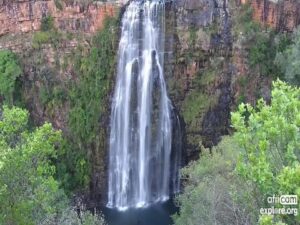
The sanctuary itself offers guided tours and overnight stays in eco-lodges. Right beside it, the Petites Chutes de la Lukaya are the small falls of the Lukaya River, with natural pools and rapids that swell in the rainy season. Mont Ngafula’s other well-known spots include Lake Ma-Vallee, ringed by some of the commune’s remaining dense forest, and the Sainte Marie de Kimwenza mission, one of the earliest Catholic parishes in Kinshasa.
Central Kinshasa lies about 20 kilometers (12 miles) north. The National Museum of the Democratic Republic of the Congo holds the country’s national collections, and the Academie des Beaux-Arts is the city’s fine arts school. The Kinshasa Botanical Garden began in colonial times as Parc De Bock, with the city’s zoological garden beside it. On Mont Ngaliema, once Mount Stanley, a presidential park holds the open-air Theatre de Verdure, and the riverbanks of Gombe look out over the Congo River at sunset.
Another great ape sanctuary in DR Congo, then primates and wildlife elsewhere:
A forest clearing at the sanctuary, with a lily-covered stretch of water on the left, a sandy path along the bank and dense forest behind, where the bonobos walk, sit and gather. The Bonobo Nursery tab shows the climbing frame where orphaned infants spend time with their caregivers.
Just south of Kimwenza at the Petites Chutes de la Lukaya, in the Mont Ngafula commune on Kinshasa’s southern edge, about 20 kilometers (12 miles) south of the city center in Gombe.
Yes. The sanctuary runs guided tours and offers overnight stays in eco-lodges, and it welcomes thousands of Congolese visitors a year through its education programs. Check with the sanctuary for current visiting days and ticket prices before going.
Only in DR Congo, in the humid forests south of the Congo River and north of the Kasai River. The river has kept them apart from common chimpanzees, which live on its north side.
Explore.org, which runs this bonobo live cam, lists the best viewing hours as midnight to 9:30 am Pacific Daylight Time, which is 8 am to 5:30 pm in Kinshasa (07:00 to 16:30 UTC). Mornings bring foraging and late afternoons social play. Outside those hours the nursery infants may be resting in their sleeping quarters.
Around 60, living in social groups across 30 hectares (74 acres) of forest. Others have gone back to the wild: 11 in 2008 and 14 in 2022, released into the Ekolo ya Bonobo reserve.
Hot and humid all year, with highs of 28 to 33 C (82 to 91 F). Rain falls from October to May, and June to September is a cooler, almost rainless dry season.
The best new live webcams and site features, once a week.
By subscribing you agree to receive our weekly email. Unsubscribe any time.
 20°C / 68°F
 14°C / 57.2°F
 15.8°C / 60.4°F
 25.3°C / 77.5°F