
Live


 21:29:49
 15.4°C / 59.7°F
 Clear Sky
 72%
72% 7 km/h / 4 mph
 07:38
07:38 18:21
18:21Loading forecast…

Pretare, Arquata del Tronto, Marche, Italy
12.4°C / 54.3°F
21:29
Passo Lanciano - Majelletta, SP220, Pretoro, Province of Chieti, Italy
 6.7°C / 44.1°F
21:29
6.7°C / 44.1°F
21:29
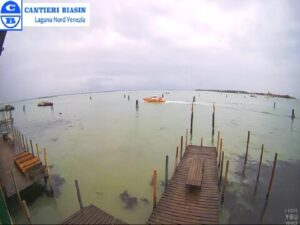
Fondamenta Serenella, 16, 30141 Venezia VE, Italy
14.3°C / 57.7°F
21:29




The Prato Webcam points across a tiled rooftop in the historic center of Prato at the crenellated walls of Castello dell’Imperatore, the only Swabian castle in central and northern Italy. The camera holds one fixed frame. A long stretch of pale limestone wall runs across the middle of the picture, square merlons along its top edge, with a squat tower breaking the line and a modern railing where the rampart walk passes behind it. Terracotta roof tiles cut across the bottom and sky fills the upper half. It refreshes as a still image rather than a video stream, so what changes here is the light and the weather. Live temperature, humidity and wind readings run alongside it.
The fortress stands on Piazza delle Carceri and has been known over the centuries as the Fortezza di Santa Barbara as well as by its imperial name. Work began around 1240 under Riccardo da Lentini, the Sicilian architect who built for Frederick II of Swabia, Holy Roman Emperor and King of Sicily. It went up on the remains of an earlier stronghold, the Palazzolo of the Alberti counts, which had already been besieged in 1107 by Countess Matilda of Canossa. The Swabian castles are otherwise a southern Italian family, and this was the emperor’s northern outpost.
The plan is a near perfect square with eight towers, four at the corners and four set along the walls between them. The same eight part geometry governs Castel del Monte in Puglia, designed for the same emperor within the same decade. The curtain walls reach 2.5 meters (8 feet) in thickness and are built from Alberese, the pale limestone quarried in the hills around the city, which gives the fortress the flat monolithic look the camera picks up in strong sun. The pointed entrance portal is the one piece of decoration, banded in the Tuscan two color manner with green serpentine from nearby Monteferrato set against the pale stone, and topped by two carved lions of the Hohenstaufen house.
Building stopped when Frederick II died and the interior was never completed, which is why the walls enclose an open space rather than rooms. In 1351, after Prato passed to the Florentine Republic, the castle was linked to the Cassero, a raised and fortified walkway roughly 230 meters (755 feet) long that let a garrison reach the fortress from the city walls without stepping into the street. The building was damaged during the fascist period and has been under restoration since. It now belongs to the Municipality of Prato and admission is free. The city around it holds 198,327 people, sits at 65 meters (213 feet) above sea level on the Bisenzio river, and lies about 15 kilometers (9 miles) northwest of Florence.
Prato has a transitional Mediterranean climate, with damp cool winters and hot dry summers. January runs from about 3.1 to 10.6 C (38 to 51 F), and on clear nights the temperature often drops close to 0 C (32 F), which is when morning fog forms in the Bisenzio valley and can soften the wall to a grey outline for an hour or two after sunrise. Spring warms quickly: April averages 9.0 to 19.8 C (48 to 68 F), and the lower sun of the shoulder seasons throws the merlons into relief.
July is the hot month, from 19.4 to 32.0 C (67 to 90 F), and every summer brings a handful of days reaching 36 to 38 C (97 to 100 F), though the humidity stays moderate. Afternoon thunderstorms build over the hills from June through August. Rainfall totals 935 millimeters (36.8 inches) a year over 89 days, unevenly spread: July is the driest month at 30 millimeters (1.2 inches), November the wettest at 135 millimeters (5.3 inches). October holds between 12.0 and 21.1 C (54 and 70 F). The city collects 2,330 hours of sunshine a year, peaking at 10.5 hours a day in July.
The Basilica di Santa Maria delle Carceri shares the square with the fortress, and the castle’s own rampart walkways can be climbed for free, which puts the basilica dome and the old town roofs at eye level. Five minutes north is Prato Cathedral, dedicated to Santo Stefano, alongside the Prato Cathedral Museum. Palazzo Pretorio, on the neighboring piazza, houses the civic museum and its collection of Tuscan painting. Palazzo Datini, home of the fourteenth century merchant Francesco Datini, and Palazzo degli Alberti with its art gallery sit within the same few blocks, as do the churches of San Domenico, San Francesco and Sant’Agostino.
Prato made its money in cloth, and the Prato Textile Museum sets out that history in a converted mill. On the southern edge of the city, the Centro per l’arte contemporanea Luigi Pecci is one of the older contemporary art institutions in Italy. Teatro Metastasio stages the city’s drama season. For a walk out of town, the Monteferrato hills that supplied the green serpentine in the castle portal rise immediately to the northwest and carry marked trails.
The Prato Webcam sits well alongside these other Italian views.
It stands on Piazza delle Carceri in the historic center of Prato, in Tuscany, about 15 kilometers (9 miles) northwest of Florence. The city sits at 65 meters (213 feet) above sea level on the Bisenzio river.
A fixed view of the monumental walls of the castle: a long run of pale limestone, the square merlons along the parapet, a tower breaking the line and the rampart railing behind. Terracotta roof tiles fill the foreground.
Winters are cool and damp, with January between 3.1 and 10.6 C (38 and 51 F) and nights near freezing under clear skies. Summers are hot, July running 19.4 to 32.0 C (67 to 90 F) with occasional afternoon thunderstorms.
It was built for Frederick II of Swabia, Holy Roman Emperor and King of Sicily, with work starting around 1240 under the Sicilian imperial architect Riccardo da Lentini. Construction halted at the emperor’s death.
Yes. The castle belongs to the Municipality of Prato, admission is free, and the walkways along the top of the walls are open, giving a view over the city and the neighboring basilica.
Alberese, a pale limestone from the hills around Prato, in walls 2.5 meters (8 feet) thick. The entrance portal adds bands of green serpentine quarried at Monteferrato and two carved Hohenstaufen lions.
The operator runs it as a refreshing still from a low power mini PC, framed for tourism and weather rather than surveillance, with the angle set so faces and vehicle plates cannot be read. Four low resolution archive stills, taken at dawn, midday, sunset and night, are overwritten every 24 hours.
The best new live webcams and site features, once a week.
By subscribing you agree to receive our weekly email. Unsubscribe any time.
 0.3°C / 32.5°F
 -2.3°C / 27.9°F