Live
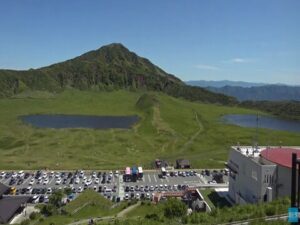
Mount Nakadake, Japan
Kusasenri Observatory, 1662-9 Nagakusa, Aso, Kumamoto, Japan
 14.8°C / 58.6°F
 07:22
 07:22:47
 19.4°C / 66.9°FOvercast Clouds
 97%
 2 km/h / 1 mph
 06:02
 17:09
Loading forecast…
Kusasenri Observatory, 1662-9 Nagakusa, Aso, Kumamoto, Japan
14.8°C / 58.6°F
07:22

Awaji Monkey Center, 289 畑田組 Sumoto, Hyogo, Japan
21.4°C / 70.5°F
07:22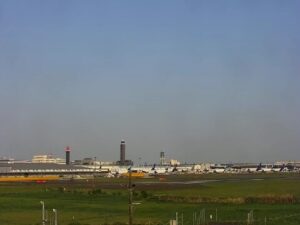
Narita International Airport (NRT), 1-1 Furugome, Narita, Chiba, Japan
 18°C / 64.4°F
07:22
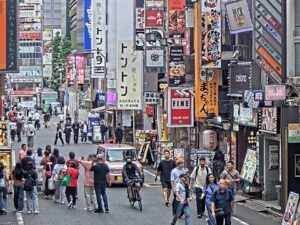

Peace Memorial Park, Nakajimachō, Naka Ward, Hiroshima, Japan
22.1°C / 71.8°F
07:22


The Toyama Webcam looks out from the roof of Tower 111, a 22-story building just northeast of Toyama Station, across the densest blocks of the city toward a line of hills on the southern horizon. Local broadcaster Tulip TV runs it as its city information camera. Mid-rise buildings fill most of the frame, a long straight avenue cuts through the middle, and two red-and-white lattice masts stand out against the grey and white roofs. On a clear day the hills come up sharp behind the city, while summer haze and wet winter weather can fade them to a pale outline or hide them completely. After dark the picture turns into street lights and lit windows. A second tab switches to Tulip TV’s camera at the south exit of Toyama Station.
Tower 111 takes its name from its height. The roof stands 111 meters (364 feet) above the street and the antenna spire tops out at 120.5 meters (395 feet). Completed in 1994 with 22 floors above ground, it was still the tallest structure in Toyama Prefecture in 2011, so the camera sits well above everything around it. The building, also listed as the INTEC Building, stands in Ushijima-Shinmachi about 400 meters (1,300 feet) northeast of Toyama Station. That puts the camera on the north side of the railway, looking roughly south over the station district toward the old center of the city.
Toyama is the capital of Toyama Prefecture and faces Toyama Bay on the Sea of Japan coast of central Honshu. The city had an estimated 415,844 residents in 2019, and its municipal area covers 1,241.77 square kilometers (479 square miles), far more ground than the compact core on screen.
The city grew up around Toyama Castle, founded as a fort in 1543. The keep that stands in Castle Park today is a reinforced-concrete reconstruction from 1954 and holds a small history museum. During the Edo period the local rulers promoted the production of Chinese-style medicine, and Toyama became known across Japan as the province of medicine, a reputation the city still carries.
Winters are cold, wet and snowy. January averages a high of 6.3 C (43 F) and a low of 0.2 C (32 F), and the Japan Meteorological Agency record puts average seasonal snowfall at 253 centimeters (100 inches). On the camera, winter often means low grey cloud, snow lying on the flat roofs and days when the hills are gone altogether. Spring warms quickly. April runs from about 7.4 C (45 F) at night to 17.6 C (64 F) by day, and the cherry trees in Castle Park come into flower.
Summer is hot and humid, with August averaging 31.4 C (89 F) by day and 23.2 C (74 F) at night. Summer haze can flatten the far hills into a faint band. Autumn cools steadily, with October highs near 21.6 C (71 F) and lows of 13.1 C (56 F). Rain falls in every season and adds up to 2,374 millimeters (93 inches) a year, so wet streets and cloud sitting low over the rooftops are a familiar sight in this frame.
Fugan Canal Kansui Park lies about 750 meters (half a mile) north of Tower 111. The canal basin is crossed by the Tenmon-kyo Bridge, whose towers are lit at night, and a glass-walled lakeside cafe looks straight onto the water. South of the station, Castle Park has gardens, the remains of the moat, cherry trees and the rebuilt keep with its museum. The Toyama Glass Art Museum occupies floors 4 to 6 of the Toyama Kirari building, designed by Kengo Kuma and opened in 2015, around a tall atrium lined with timber. For a view much like this camera’s, the observation tower at Toyama City Hall takes a free elevator to about 70 meters (230 feet), and on clear days the Tateyama range shows on the skyline.
The Portram light rail runs north from the station to Higashi-Iwase in about 25 minutes, and a five-minute walk leads into Iwase, an old port district that prospered in the days of the Kitamaebune trading ships. Inland, the Tateyama Kurobe Alpine Route crosses the Northern Alps in a 90 kilometer (56 mile) chain of trains, cable cars and buses, which takes 7 to 8 hours one way, while a round trip as far as Murodo takes 5 to 6 hours. Back in the city, look for Toyama Black ramen with its dark soy broth, shiroebi white shrimp, hotaruika firefly squid and buri yellowtail from the bay.
These cameras cover more of central Japan, from the Sea of Japan coast to the Northern Alps.
The main camera looks roughly south from the roof of Tower 111 over central Toyama. The frame is mostly city blocks, with a long straight avenue running away from the camera, two red-and-white lattice masts, and hills along the horizon when the air is clear.
It is mounted on Tower 111 in Ushijima-Shinmachi, about 400 meters (1,300 feet) northeast of Toyama Station, in the city of Toyama. Toyama is the capital of Toyama Prefecture on the Sea of Japan coast of central Honshu.
Yes. The second tab on this page carries Tulip TV’s Toyama Station camera, which faces the south exit of the station with its bus roundabout and tram stop. Tulip TV describes it as watching the city trams run into the station building, along with the weather and foot traffic.
Not the main Tateyama peaks. The camera faces roughly south, while the Tateyama range rises to the east-southeast of the city, outside the frame. Tulip TV covers the range with a separate live camera at Murodo on the Tateyama Kurobe Alpine Route.
The fastest Kagayaki trains on the Hokuriku Shinkansen take about 2 hours 8 minutes from Tokyo to Toyama Station, which is a short walk from the building that carries this camera.
Toyama has cold, snowy winters, with January averaging 6.3 C (43 F) by day and 0.2 C (32 F) at night, and hot, humid summers, with August highs of 31.4 C (89 F). Rain and snow add up to 2,374 millimeters (93 inches) a year, so the camera often shows cloud or wet streets.
Tulip TV says the stream can be rewound by up to 12 hours on YouTube, which is the easiest way to see the city in daylight while it is dark in Toyama. The operator also notes that the broadcast can stop at short notice.
Toyama is known across Japan for its long history of medicine making, for glass art, and for seafood from Toyama Bay such as white shrimp and firefly squid. Toyama Black ramen, with its dark soy broth, is the city’s best-known bowl.
Source: Tulip TV
The best new live webcams and site features, once a week.
By subscribing you agree to receive our weekly email. Unsubscribe any time.
 26.1°C / 79°F
 9.7°C / 49.5°F