Live

 03:07:35
 14.4°C / 57.9°F
 Overcast Clouds
 95%
 6 km/h / 4 mph
 05:59
 17:08
Loading forecast…

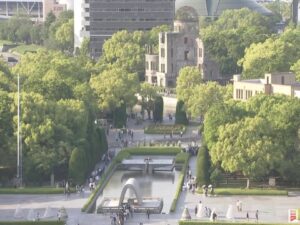
Peace Memorial Park, Nakajimachō, Naka Ward, Hiroshima, Japan
22.2°C / 72°F
03:07
Awaji Monkey Center, 289 畑田組 Sumoto, Hyogo, Japan
 22.5°C / 72.5°F
03:07

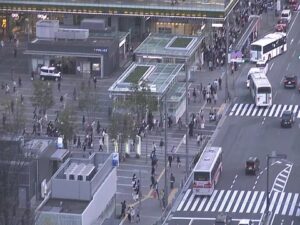
Hakata Station, 中央街-1 博多駅 Hakata Ward, Fukuoka, Japan
24°C / 75.2°F
03:07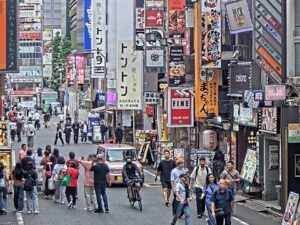
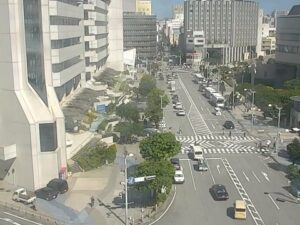


Hiroshima Airport (HIJ) (HIJ), 64-31 本郷町善入寺 Mihara, Hiroshima, Japan
20°C / 68°F
03:07
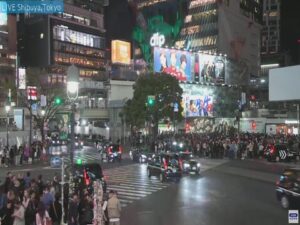
Shibuya Scramble Crossing, 21 Udagawa-cho, Shibuya City, Tokyo, Japan
21.2°C / 70.2°F
03:07
The Kiso Observatory Webcam points at the sky above the University of Tokyo’s observatory in the mountains of Nagano Prefecture, Japan. The silver dome of the Kiso Schmidt telescope sits at the bottom center of the frame on a dark line of forested ridge, with higher mountains at the left and right edges, and everything above it is sky. By day that means drifting cumulus, grey rain cloud or clear blue, and low cloud can hang on the peaks to the right. After dark a high-sensitivity camera turns the same view into a star field, and the stream is run as a meteor watch. The broadcast comes from the observatory and the Asahi Shimbun newspaper, credited as U-Tokyo & Asahi Shimbun.
Kiso Observatory opened in 1974 as a branch of the Tokyo Astronomical Observatory, set up specifically to study objects beyond our own galaxy. Since 1988 it has belonged to the Institute of Astronomy in the University of Tokyo’s Faculty of Science. The site stands at 1,130 meters (3,707 feet) in Kiso town, 16.9 kilometers (10.5 miles) southeast of the summit of Mount Ontake.
The dome on camera is 16 meters (52 feet) across and houses the 105 cm Kiso Schmidt telescope, a wide-field instrument that the operator counts among the largest Schmidt telescopes in the world. Its camera, Tomo-e Gozen, is built from 84 CMOS sensors and can film the sky at two frames per second, and the operator describes the pair as hunting for unknown astronomical events. A smaller 30 cm (12 inch) robotic telescope, added in 2002, is used mainly for repeated observations of variable stars.
The sky camera is separate from the research telescopes: a Sony FX3 with a Sigma 24 mm f/1.4 lens, covering a field of about 70 by 50 degrees. It is one of several sky cameras on the Asahi Shimbun’s astronomy channel, which also streams from Maunakea in Hawaii and the ALMA array in Chile. Questions or fault reports about the stream go to the newspaper, because the observatory asks for no phone calls that would interrupt observing.
Ten years of modeled weather data for the site (2016 to 2025) give January highs of about 1 C (34 F) and nights near minus 8 C (18 F). The Kaida Kogen weather station, elsewhere in Kiso town, records about 430 centimeters (169 inches) of snow a year, so the ridge around the dome can sit under snow through winter. Winter is also the driest season, with roughly 105 to 125 millimeters (4 to 5 inches) of precipitation a month from November to February. Spring warms slowly: April days reach about 13 C (55 F), while nights stay close to freezing at 1 C (34 F).
Summer is the wet season. July and August highs run 24 to 26 C (76 to 78 F) with nights around 16 to 17 C (61 to 62 F), and July is the wettest month, with about 356 millimeters (14 inches) of rain, so a clear summer night on camera is never a given. October brings days near 16 C (61 F) and nights around 6.5 C (44 F), and by November the nights drop to about freezing again.
The observatory takes visitors outside the winter months. An exhibition room on the ground floor of the Schmidt dome shows research posters and astronomical images, and a second-floor room shows the telescope itself. Early each August a special open day lets visitors into the dome, with talks by astronomers and night viewing through telescopes when the weather allows. No booking is needed, although the access road is narrow and winding.
Down in the valley, 9.1 kilometers (5.7 miles) northeast, the Fukushima Sekisho site in Kiso-Fukushima marks one of the checkpoints the Tokugawa shogunate set up on the Nakasendo, the old highway between Edo and Kyoto. The barrier ran from the early 1600s until 1868, its east and west gates were rebuilt after excavations in 1975, and it became a National Historic Site in 1979. Fukushima-juku was the 37th post station on the Nakasendo and the fifth of eleven on the Kisoji, the stretch through the Kiso Valley. To the northwest, Mount Ontake rises to 3,067 meters (10,062 feet), Japan’s second-highest volcano after Mount Fuji and a sacred mountain for shugendo pilgrims. Its crater lake Ni no Ike, at 2,905 meters (9,531 feet), is the highest mountain lake in Japan, and the eruption of September 27, 2014 killed 63 people.
For another telescope under the night sky, or more of Nagano’s mountains and history, try these:
Kiso Observatory is in Kiso town, Kiso District, in Nagano Prefecture in central Japan, at 1,130 meters (3,707 feet). It lies about 8 kilometers (5 miles) southwest of Kiso-Fukushima Station and 16.9 kilometers (10.5 miles) southeast of the summit of Mount Ontake.
Mostly sky. The silver Schmidt telescope dome sits at the bottom center on a forested ridge, with mountain ridges at both edges. By day the picture shows cloud and blue sky; at night it shows stars, passing cloud and, at times, meteors. A clock and a “KISO Observatory UTokyo” caption sit in the bottom right corner.
No. The University of Tokyo runs it through its Institute of Astronomy, but the observatory is in the mountains of Nagano Prefecture, about 194 kilometers (120 miles) west of central Tokyo in a straight line.
Yes, when the sky is clear. The stream is set up as a meteor watch, using a camera that can run as high as ISO 204,800 behind a fast 24 mm f/1.4 lens, so stars and brighter meteors show across its wide field. Major showers such as the Perseids in August and the Geminids in December are the best nights to watch.
It has an aperture of 1.05 meters (41 inches), a focal length of 3,300 millimeters (130 inches) and a focal ratio of f/3.1. Its Tomo-e Gozen camera covers about 20 square degrees of sky in a single view.
Yes, from April to December. The exhibition room in the Schmidt dome opens daily, from 10:00 to 17:00 between April and October and from 10:00 to 16:00 in November and December, and it is closed from January to March. No appointment is needed.
January days reach about 1 C (34 F) and nights fall to about minus 8 C (18 F), while July and August highs run 24 to 26 C (76 to 78 F). July is the wettest month, and winter can bring deep snow to the ridges around the site.
Source: Asahi Astro LIVE
The best new live webcams and site features, once a week.
By subscribing you agree to receive our weekly email. Unsubscribe any time.
 20.6°C / 69.1°F
 27°C / 80.6°F