Live

 11:57:51
 12.5°C / 54.5°F
 Scattered Clouds
 80%
 18 km/h / 11 mph
 07:21
 16:48
Loading forecast…
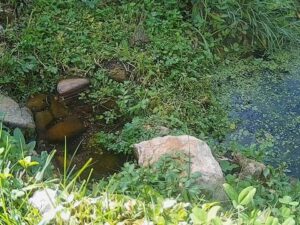
The Wildlife in the Forest Webcam watches a small woodland stream in northern Denmark, where badgers, red foxes and beech martens come to a feeding spot beneath an old tree. The camera belongs to Danish wildlife photographer Morten Hilmer and stands in his own backyard, on 11 hectares (27 acres) of land he is letting return to the wild. By day the frame takes in a muddy bank, mossy logs, stones and ferns, with grass and brush rising behind the water. Birds and squirrels pick through the seeds in daylight. After dark the picture turns to black-and-white infrared, and that is when badgers are most often on screen.
Morten Hilmer is a Danish nature photographer and Nikon ambassador who began photographing wildlife while serving two years in northern Greenland with the Danish military’s special forces. He set up the forest camera in March 2021 to learn about the animals living around his home. It ran on his main YouTube channel at first, and by July 2022 it had passed 8.4 million views, so he gave it a channel of its own, Nature Live Camera. The current broadcast has been running since May 2023.
The setup is simple. A stream runs past the roots of an old tree, and every second or third day Hilmer puts out peanuts, cat pellets, corn and sunflower seeds. He adjusts the amount to how much wildlife is about, aiming to draw animals in without making them depend on the food or changing how they forage.
European badgers, red foxes and beech martens, also called stone martens, are the regulars. A community of viewers has logged what appears since April 2021, and their shared records include identification sheets and family trees for individual badgers, foxes, martens and raccoon dogs. Deer, squirrels and a range of woodland birds are in the logs too.
Raccoon dogs have the most unusual story of the group. The species is native to East Asia, was first recorded in Jutland in 1980 and began spreading across Denmark from western Jutland around 2009. The European Union listed it as an invasive species in 2017 because of the harm it can do to native birds and small mammals, and Danish authorities have spent years trying to remove it from Jutland.
Northern Denmark has a mild, damp climate for its latitude, with the sea never far away. In Aalborg, the region’s main city, the Danish Meteorological Institute’s 1991 to 2020 averages give January highs of 3.4°C (38°F) and lows of -1.1°C (30°F), so winter at the stream is usually wet and grey rather than deep frozen, although a cold spell can leave snow on the bank. Spring warms slowly, with April highs around 11.5°C (53°F) and lows near 3.7°C (39°F).
Summer is the brightest time of year, with July highs of 21.1°C (70°F), lows of 13.2°C (56°F) and about 218 hours of sunshine in June. At Aalborg’s latitude the sun is up for almost 18 hours around midsummer, so evening light lingers long before the infrared takes over. October brings highs of 12°C (54°F), lows near 6.3°C (43°F) and fallen leaves along the water, and by late December daylight lasts under seven hours. Aalborg records about 600 mm (24 inches) of precipitation a year.
The camera’s exact location is private, but the region’s protected areas hold the same animals and more. Lille Vildmose, about 45 km (28 miles) southeast of Aalborg, is the largest remaining raised bog in northwestern Europe at 7,600 hectares (19,000 acres). Around 550 red deer live there with wild boar, otters and foxes, along with moose brought from Sweden in 2016 and 2017 and European bison introduced from 2019. Golden and white-tailed eagles breed on the bog, wolves have been recorded since 2021, and the Lille Vildmosecentret visitor center is the place to start.
Rold Skov, south of Aalborg, is Denmark’s second-largest forest at 8,000 hectares (19,700 acres), after the Silkeborg forests. Its northern part takes in the heather-covered hills of Rebild National Park, and the woods hold springs, streams and lakes around the towns of Rebild and Skorping. On the west coast, Thy National Park opened in 2008 as the first national park in Denmark proper. It covers 244 square kilometers (94 square miles) of dunes, heath and small lakes along 55 km (34 miles) of North Sea coast. Red deer roam there, and its Hanstholm reserve, the largest connected sandy heath in Denmark, is the only place in the country where the European golden plover breeds.
Badgers also visit the barn owl camera in England’s Peak District, and Frederikshavn is a port town in the same northern corner of Denmark.
A stream bank under an old tree on private woodland in northern Denmark, where food is put out every few days. Badgers, red foxes and beech martens are the regular visitors, and viewers have also logged raccoon dogs, deer, squirrels and birds. In daylight the frame shows mossy logs, stones and ferns around the water; at night the picture is black-and-white infrared.
In northern Denmark, on the 11 hectares (27 acres) of land around Morten Hilmer’s home. He does not publish the exact location, so the map pin marks the region rather than the property.
Morten Hilmer, a Danish wildlife photographer and Nikon ambassador. He started the camera in March 2021 and later moved it to its own YouTube channel, Nature Live Camera.
Yes. After dark the camera switches to infrared, so the picture is black and white but still shows badgers and foxes at the water. Night is often the busiest time, because badgers mostly come out after dark.
No. Wildlife in the Forest is the name of Morten Hilmer’s stream in northern Denmark. It has no connection with the Forest of Dean or the New Forest in England, or with the Black Forest in Germany.
On YouTube, yes. The broadcast keeps up to 12 hours of footage, so a morning visit can still catch the night’s badgers. Viewers time-stamp their sightings in the live chat, so others can jump straight back to them.
Mild and damp for the latitude. Aalborg averages highs of 3.4°C (38°F) in January and 21.1°C (70°F) in July, with about 600 mm (24 inches) of precipitation a year.
Source: Nature Live Camera
The best new live webcams and site features, once a week.
By subscribing you agree to receive our weekly email. Unsubscribe any time.
 12.8°C / 55°F
 12.8°C / 55°F

 13.8°C / 56.8°F