
Live

 06:07:01
 8.7°C / 47.7°F
 Light Rain
 87%
87% 43 km/h / 27 mph
 07:38
07:38 16:41
16:41Loading forecast…




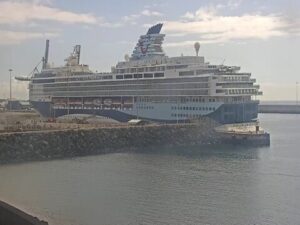
Cruise Pirs Arrecife, Avenida de los Marmoles, Arrecife, Spain
 22.1°C / 71.8°F
06:07
22.1°C / 71.8°F
06:07
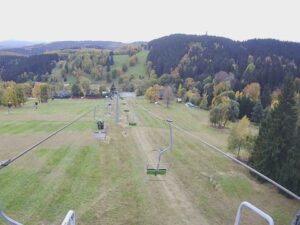
Paprsek, Velke Vrbno, Olomouc Region, Czech Republic
 -0.8°C / 30.6°F
07:07
-0.8°C / 30.6°F
07:07
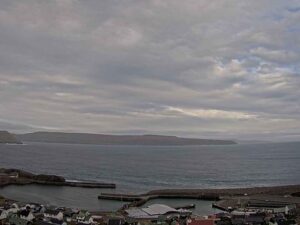
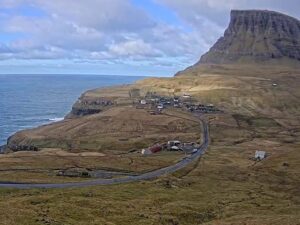
The Hvannasund Webcam looks south-east over the narrow sound that separates Vidoy from Bordoy in the north-east of the Faroe Islands. A steep mountainside striped with bands of dark rock rises on the left, with the houses and small boat harbor of Hvannasund strung along the shore beneath it. The causeway to Nordepil crosses the water in the middle of the frame, and beyond it the sound runs on between green slopes toward open water. Weather moves through this view quickly. Haze and low cloud can sit over the ridgeline in the morning and clear by midday, and on autumn mornings the sun climbs into the top of the frame above the strait, turning the mountains into silhouettes before the light moves round onto the grassy ledges in the afternoon.
Hvannasund sits on the west coast of Vidoy, one of the Nordoyar, the northern islands of the Faroes. The village shares its name with the sound in front of it, and directly across that water lies Nordepil on Bordoy. A causeway joins the two villages, and with them the two islands, and both now belong to the same municipality, Hvannasunds kommuna. Hvannasund already appears in the first Faroese land register, drawn up in 1584. Its population grew from 138 people in 1966 to 264 in 2025, and the whole municipality counted 423 residents in September 2025.
The village is the departure point for the passenger ferry to the small islands of Svinoy and Fugloy. Its church was built by local people and consecrated on 13 November 1949. North of the houses lies Skrudhettan, a large cracked rock that, according to an old legend, split at the very moment Jesus was born.
Nordepil, on the Bordoy side of the causeway, had 158 residents at the start of 2025. It has an industrial past that is easy to miss today: a Norwegian whaling station opened there in 1897 and ran until it closed down after 1912. The camera looks down on the causeway from higher ground, so both villages, the moorings and the road across the water all fit into one wide frame.
The Faroe Islands have a mild, wet oceanic climate with small differences between the seasons. At the official station in Torshavn, the capital, Danish Meteorological Institute averages for 1991 to 2020 give January a typical high of 6.2 C (43 F) and a low of 2.1 C (36 F). July reaches about 12.9 C (55 F) by day and 9.1 C (48 F) at night. Spring is slow to arrive, with April highs of only 7.6 C (46 F), while October still averages 9.6 C (49 F). At least 1 millimeter of precipitation falls on about 192 days a year, adding up to roughly 1,400 millimeters (55 inches), and the islands record only about 1,000 hours of sunshine annually. The heat record at Torshavn is 22 C (72 F) and the cold record is minus 11 C (12 F).
Latitude shapes the view as much as the weather does. At just over 62 degrees north, Hvannasund gets only about five hours of daylight around the winter solstice, so for most of a December day the Hvannasund Webcam shows the strait in darkness. Around midsummer the sun is up for close to 20 hours, and the sky over the sound never gets darker than twilight. Even in early October the grassy ledges on the mountainside are still green between the bands of bare rock, and a clear afternoon can turn the water a deep blue against the slopes.
The ferry from Hvannasund is the way to reach Svinoy and Fugloy, and the round trip takes about two hours. Further north on Vidoy, Vidareidi is the northernmost settlement in the Faroe Islands. Its church keeps a collection of silver that includes a salver presented by the British government in thanks for help given to sailors rescued from a wreck in the mid-19th century. Near Vidareidi, the Enniberg cliff drops 754 meters (2,474 feet) to the sea and is often described as the second-tallest sea cliff in Europe.
Klaksvik, the regional center of the northern islands, lies across on Bordoy. From its harbor the ferry Sam crosses to Sydradalur on Kalsoy in about 20 minutes. On Kalsoy, a walk from Trollanes leads out to the Kallur lighthouse, the island has a James Bond tombstone left as a reminder that No Time to Die was filmed there, and the village of Mikladalur has a statue of Kopakonan, the seal woman of Faroese legend.
More live views from the Faroe Islands and the North Atlantic:
Hvannasund is on the west coast of Vidoy in the Nordoyar, the northern islands of the Faroes. It faces Nordepil on Bordoy across a narrow sound, and the two are linked by a causeway. Klaksvik, the nearest town, is about 8.7 kilometers (5.4 miles) to the south-west in a straight line.
The camera looks south-east along the sound. Hvannasund’s houses and boat harbor sit under a steep, layered mountainside on the left, the causeway to Nordepil crosses the water in the middle, and the strait continues between the mountains of Vidoy and Bordoy into the distance.
Yes. The stream has no scheduled off hours and runs around the clock. During the long winter nights the picture is dark for much of the day, and the view returns as soon as the sun is up again.
A passenger ferry sails from Hvannasund to the islands of Svinoy and Fugloy. A round trip takes about two hours.
By a causeway across the sound. It joins Hvannasund on Vidoy to Nordepil on Bordoy, and both villages belong to the same municipality, Hvannasunds kommuna.
The church was built by local people and consecrated on 13 November 1949.
Mild and wet for most of the year. Typical highs run from about 6 C (43 F) in January to about 13 C (55 F) in July, precipitation falls on roughly 192 days a year, and cloud often hangs over the mountain ridges around the sound.
Source: Faroe Islands Live
The best new live webcams and site features, once a week.
By subscribing you agree to receive our weekly email. Unsubscribe any time.
 9.6°C / 49.3°F
 3.3°C / 37.9°F
 -2.8°C / 27°F