Live

 21:15:31
 8.6°C / 47.5°F
 Overcast Clouds
 67%
67% 8 km/h / 5 mph
 08:29
08:29 17:52
17:52Loading forecast…
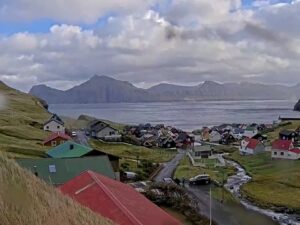
The Nolsoy Webcam looks down a grassy hillside at Nolsoy village, the only settlement on the small Faroese island of the same name, 4 kilometers (2.5 miles) east of Torshavn. Colored houses crowd the low ground in the middle of the frame, a stone breakwater curls around the harbor in front of them, and a single wind turbine stands on the ridge behind. Open water fills the left side of the picture. In the foreground, the hay fields still carry the old strip pattern of Faroese farmland, and in summer the mown rows show up as pale stripes in the grass. Most of the movement on screen comes from the sky: cloud shadows slide across the slope, showers blow through from the sea, and the water turns from slate gray to deep blue when the sun breaks out.
Nolsoy covers 10.3 square kilometers (4.0 square miles) and lies across a narrow sound from the Faroese capital. Its one village sits on the northwest coast, on the Stongin peninsula, which is joined to the rest of the island by an isthmus only a few meters wide. The name fits that shape. It comes from the Old Norse word nor, meaning a narrow stretch of land in a body of water. The village had 218 residents in September 2025. South of it, the island rises to Eggjarklettur on the mountain Hogoyggj, 372 meters (1,220 feet) above the sea, the highest point on Nolsoy.
The island is best known for its seabirds. Around 50,000 pairs of European storm petrels breed here, one of the largest colonies of the species in the world, alongside about 30,000 pairs of Atlantic puffins and roughly 100 pairs of black guillemots. The petrels are active at night, which is why the walks to see them run in the evening.
Two figures from Faroese history belong to this village. Nolsoyar Pall, a national hero and freedom fighter who took his name from the island, challenged the Royal Trade Monopoly and captained Royndin Frida, described as the first Faroese ocean-going vessel since the early Middle Ages. In 1986 Ove Joensen rowed a traditional Faroese boat all the way to Denmark. He drowned the following year, and Nolsoy remembers him every August with Ovastevna, its village festival. An arch made from whale bones, which has appeared on Faroese stamps, is another of the village landmarks.
Nolsoy shares the maritime climate of Torshavn, 4 kilometers (2.5 miles) away, where the Atlantic keeps winters mild and summers cool. January averages highs of 6.2 C (43 F) and lows of 2.1 C (36 F). April is barely warmer at 7.6 C (46 F) by day, July reaches 12.9 C (55 F) with nights around 9.1 C (48 F), and October still manages 9.6 C (49 F). Torshavn records about 1,400 millimeters (55 inches) of precipitation on roughly 192 days a year and only about 1,000 hours of sunshine, so the Nolsoy Webcam shows low cloud, drizzle and passing showers far more often than a clear sky.
Latitude changes the view as much as the weather does. At 62 degrees north, the sun is up for close to 20 hours around the June solstice, and the hillside can stay lit late into the evening. In late December the day shrinks to about five hours, so the picture is dark for most of each winter day and the best light comes around midday. The fields show the seasons clearly: bright green in early summer, striped with cut hay by August, and already fading toward yellow by the end of September.
The ferry Ternan crosses from Torshavn harbor to Nolsoy in about 20 minutes, which makes the island an easy day trip from the capital. The village is small enough to explore on foot: through the lanes of colored houses, past the whale bone arch, and out to the breakwater that frames the harbor on the camera. Ovastevna is held at the beginning of August, and the ruins in Korndalur, the Corn Valley, are tied to the local legend of the Princess of Nolsoy.
The longest walk on the island heads south to the two lighthouses near its tip, the older of them built in 1893. The round trip takes five to six hours and looks back across the sound to Torshavn. Hikers can also climb Hogoyggj to Eggjarklettur, the island’s summit, or follow the rough trail along the rocky east coast, which is used mostly by sheep farmers and by storm petrel tours. Those tours are guided evening walks to the colony and include an overnight stay on the island, since the birds only become active after dark.
More Faroese villages and harbors are on camera across the islands.
Nolsoy is an island in the Faroe Islands, 4 kilometers (2.5 miles) east of the capital, Torshavn, and part of Torshavn Municipality. Its only village, the one on the camera, sits on the northwest coast facing the capital.
The camera looks down a grassy slope at Nolsoy village, with its colored houses, the stone breakwater around the harbor and a wind turbine on the hill behind. Open water fills the left of the frame, and the hay fields in the foreground show the changing seasons.
Mild, wet and changeable. Nearby Torshavn averages highs of 6.2 C (43 F) in January and 12.9 C (55 F) in July, with about 1,400 millimeters (55 inches) of precipitation and only around 1,000 hours of sunshine a year.
The ferry Ternan sails from Torshavn harbor and reaches Nolsoy in about 20 minutes. It docks at the village, so the harbor on the camera is where most visitors arrive.
Nolsoy has one of the largest European storm petrel colonies in the world, with around 50,000 breeding pairs. The birds are active at night, so guided tours run as evening walks with an overnight stay on the island.
The return walk from the village to the two lighthouses near the southern tip takes five to six hours. The older of the two was built in 1893.
Nolsoyar Pall is a Faroese national hero and freedom fighter who took his name from the island. He opposed the Royal Trade Monopoly and captained Royndin Frida, described as the first Faroese ocean-going vessel since the early Middle Ages.
At 62 degrees north, late December has only about five hours of daylight, so the picture is dark for most of the day. The camera keeps streaming, and the view returns with the light each morning.
Source: Faroe Islands Live
The best new live webcams and site features, once a week.
By subscribing you agree to receive our weekly email. Unsubscribe any time.



 6.4°C / 43.5°F
 8.2°C / 46.8°F

 1.6°C / 34.9°F
 5.6°C / 42.1°F