
Live

 08:07:26
 8°C / 46.4°F
 Scattered Clouds
 66%
66% 19 km/h / 12 mph
 07:36
07:36 18:23
18:23Loading forecast…


Dog Day Getaway, Felton Court, Apple Valley, Minnesota, USA
7.8°C / 46°F
08:07
Hyland Hills Ski Area, Chalet Road, Bloomington, Minnesota, USA
8.4°C / 47.1°F
08:07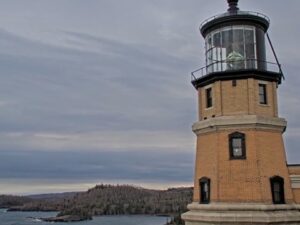
Split Rock Lighthouse, Lake County, Minnesota, USA
 8.2°C / 46.8°F
08:07
8.2°C / 46.8°F
08:07

Lake Itasca, Itasca State Park, Minnesota, USA
6.2°C / 43.2°F
08:07


Siesta Key, Midnight Pass Road, Sarasota, Florida, USA
 17.6°C / 63.7°F
09:07
17.6°C / 63.7°F
09:07
Oregon State University, Corvallis, Oregon, USA
 6.8°C / 44.2°F
06:07
6.8°C / 44.2°F
06:07
The Aitkin Webcam watches the BNSF Brainerd Subdivision at milepost 93.16 in Aitkin, Minnesota, from a perch beside the single main track on the edge of town. The camera looks across a grassy lot to the rail line, with a solid wall of mixed woods behind it and power poles tracing the right of way. As of 2021 the route carried about seven freight trains a day, most of them coal, so long quiet spells break into several minutes of locomotives and loaded hoppers rolling past. A caption on the stream sorts the traffic for you, with eastbound trains crossing to the left and westbounds to the right. Between trains the scene still moves: weather rolling in over the flat horizon, and the woods behind the ballast changing with the seasons.
Aitkin is the county seat of Aitkin County in central Minnesota, a town of 2,323 people at 376 meters (1,234 feet) above sea level. The Mississippi River flows along its northern edge, and in its early decades the town lived off the water as much as the rails, with steamboats working the river and logging outfits moving timber through the area. The railroad actually came first. Northern Pacific track reached the site in 1870, the year the town was founded, and the name honors William Alexander Aitken, a partner in the American Fur Company who ran the firm’s regional trade in the early 1800s.
That Northern Pacific line is the one on camera today. It survives as the BNSF Brainerd Subdivision, about 240 kilometers (150 miles) of track running from Staples east to Carlton, where it connects with the Lakes Subdivision toward the Twin Ports. Speed limits on parts of the route are held to 79 km/h (49 mph), so trains pass the camera at an easy pace rather than a blur. The passenger era is preserved a few blocks away at the 1916 Northern Pacific depot, now the Aitkin County Depot Museum and listed on the National Register of Historic Places. The last passenger trains, numbers 57 and 58 between Duluth and Staples, made their final calls on May 24, 1969.
Winter dominates the year here. January days average a high of -7.3 C (18.8 F) and fall to -17.7 C (0.1 F) overnight, and December is not much warmer, with typical highs of -4.2 C (24.5 F). Snow usually covers the lot and the ballast for months at a stretch, the low sun throws long shadows across the frame on clear days, and the coal trains keep running through all of it.
Summer swings the other way. July brings average highs of 26.2 C (79.1 F) with nights near 13.4 C (56.1 F), and the woods behind the track fill in to a solid green backdrop. Spring is a fast melt and a muddy lot. Fall is the reward on the Aitkin Webcam, when the trees behind the rail line turn color through late September and October before the first lasting snow returns.
Rail history is easy to reach. The Aitkin County Depot Museum occupies the 1916 Northern Pacific depot downtown and covers the railroad and river years of the county. A short walk takes in the rest of the historic core, including the 1911 Carnegie library building and the county courthouse, both on the National Register of Historic Places, along with the Jaques Art Center.
The calendar gives the town its character. The World Famous Fish House Parade rolls decorated ice fishing houses down Main Street on the Friday after Thanksgiving, complete with a Fishhouse 5K and a vintage snowmobile display, and the crowd runs into the thousands. Riverboat Heritage Days takes over the first weekend of August, the Aitkin County Fair runs in mid-July, and the Ripplesippi Music Fest adds a late summer weekend by the river. Mille Lacs Lake, one of Minnesota’s great walleye fisheries, lies just south of town, and on a busy winter night roughly 25,000 people sleep out on its ice in fish houses of their own.
More live rail action and Minnesota views to keep open in another tab.
Aitkin is the county seat of Aitkin County in central Minnesota, on the upper Mississippi River. It sits along the BNSF line between Brainerd to the west and Duluth to the northeast, with Mille Lacs Lake a short drive south.
The frame takes in the main track of the BNSF Brainerd Subdivision at milepost 93.16, with a grassy lot in front and woods behind. Freight trains, most of them coal, cross the view, with eastbounds passing to the left and westbounds to the right.
BNSF Railway owns the line, known as the Brainerd Subdivision, which runs about 240 kilometers (150 miles) from Staples to Carlton. It was built by the Northern Pacific Railway, whose track reached Aitkin in 1870.
As of 2021 the Brainerd Subdivision carried about seven trains a day, most of them coal, plus a local freight that works the line on Sundays and Wednesdays. Traffic is not evenly spaced, so quiet gaps of a few hours are normal.
Winters are long and cold, with January highs around -7.3 C (18.8 F) and overnight lows near -17.7 C (0.1 F). July averages a high of 26.2 C (79.1 F), and the shoulder seasons move quickly between the two extremes.
On the Friday after Thanksgiving, decorated ice fishing houses parade down Main Street in what the town bills as the World Famous Fish House Parade. The day includes a Fishhouse 5K run and a vintage snowmobile display, and thousands of people line the route.
Yes. The Aitkin County Depot Museum occupies the 1916 Northern Pacific depot, which joined the National Register of Historic Places in 1982. Passenger trains last called there on May 24, 1969, when numbers 57 and 58 between Duluth and Staples were discontinued.
Source: Steel Highway Railcams
The best new live webcams and site features, once a week.
By subscribing you agree to receive our weekly email. Unsubscribe any time.
 9.2°C / 48.6°F