Live

 00:10:41
 11.4°C / 52.5°F
 Broken Clouds
 81%
81% 40 km/h / 25 mph
 08:22
08:22 18:24
18:24Loading forecast…
The Runde Webcam looks into the Lundeura puffin colony on Rundabranden, the bird cliff on the west side of Runde island in Norway. Runde Environmental Centre runs the camera, and it can pan and zoom: pulled wide, it shows the grassy slope falling to the open sea on the left, the ridge climbing to a bare summit ahead and a sheer rock wall on the right. Zoomed in, it fills the frame with a boulder-strewn slope where Atlantic puffins stand at their burrow entrances by the dozen. From spring until mid August the colony is busy, and the operator says the evenings are the liveliest time, when birds return from the sea with fish. In autumn and winter the same view is an empty cliff.
Runde is a small island in Heroy municipality in More og Romsdal, on the Sunnmore coast of western Norway. It covers 6.2 square kilometers (2.4 square miles), had 113 residents at the 2015 count, and rises to Varden at 332 meters (1,089 feet). A bridge links it to the neighboring island of Remoya, and Alesund lies about 30 kilometers (19 miles) to the east-northeast as the crow flies. The camera sits on Rundabranden, the cliff that Norwegian sources call the southernmost bird cliff in the country. It lies inside the Runde nature reserve, which became a Ramsar wetland site in 2013.
Wikipedia puts the seabird population at 500,000 to 700,000 birds, with the puffin colony credited at around 100,000 pairs alongside 50,000 pairs of black-legged kittiwakes, 3,000 pairs of razorbills and 2,500 pairs of northern gannets. The puffins spend the winter far out on the North Atlantic and come back to their burrows each spring. That is a short trip next to the Arctic tern’s, which also nests along the Norwegian coast and flies to the edge of Antarctica and back each year, a route traced on our bird migration map. On this camera the first returning birds were noted in mid March 2026, and in 2025 the operator recorded the first egg of the season on 20 April. Chicks hatch from mid June and leave the burrows for the sea from early to mid August, after which the slope goes quiet.
Runde Environmental Centre, which opened on the island in 2009, is both a research station and a visitor centre. Its July 2026 update from the colony said the breeding season had gone well, with more than half of the chicks surviving according to the Norwegian Institute for Nature Research’s monitoring program, even though sand eels were scarce and the adults were feeding haddock and whiting instead.
Runde sits on the open coast, so the climate is mild for the latitude but wet and windy. Winter afternoons average 3 to 4 C (38 to 39 F) and nights hover around freezing at 0 to 1 C (32 to 34 F). Spring is slow to arrive: April highs are near 8 C (46 F) and May reaches about 11 C (52 F), when the slope greens up and the burrows fill. July and August are the warmest months, with highs of 15 to 16 C (60 to 61 F) and lows around 11 to 12 C (52 to 53 F).
Rain is the constant. The island gets roughly 2,200 millimeters (87 inches) a year, with September, October and December the wettest months at over 250 millimeters (10 inches) each. Daylight swings hard at 62 degrees north: in late June the sun sets after 11 pm, so the evening puffin rush happens in full light, while in December the sun is up for under six hours.
The main reason to visit is the colony itself. A marked trail climbs from the village to the Lundeura lookout above the puffin slope, a walk of about 45 minutes that tops out near 200 meters (656 feet) above the sea, and the best time to be there is around 8 pm on a summer evening when the birds come home. Runde Environmental Centre runs guided puffin safaris along this route and has a cafe, apartments and exhibitions, including one on the Runde treasure. That treasure comes from the Dutch merchant ship Akerendam, which left Texel on 19 January 1725 and was wrecked off Kvalneset at the north tip of the island with the loss of all 200 crew. Divers found the wreck in 1972 and recovered about 57,000 coins, among them 6,600 gold ducats.
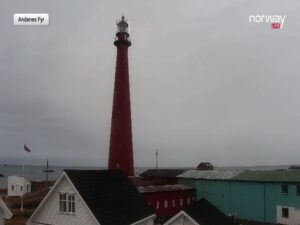
Kvalneset is also where Runde lighthouse stands. It was lit privately in 1767 as only the fifth lighthouse in Norway, the state took it over in 1807, the present concrete tower was first lit on 27 August 1935, and the last keeper left when it was automated in 2002. The Alesund-Sunnmore branch of the Norwegian Trekking Association has run the newest keeper’s house as a self-service cabin since 2003. The nearest town is Fosnavag, about 7 kilometers (4.6 miles) south across the water, and Alesund is the usual base for a day trip.
More coast and seabird views on the site:
The camera is mounted at the Lundeura puffin colony on the Rundabranden bird cliff. Wide, it shows the cliff falling to the sea on the left and the ridge rising to a bare summit; zoomed in, it shows a grassy, boulder-covered slope with Atlantic puffins at their burrows.
The puffins return to the colony in late March or April, lay eggs from around the third week of April, and the chicks leave for the sea from early to mid August. May, June and July are the months with the most birds on the slope.
Outside the breeding season the puffins live at sea and the colony is empty, so from mid August until the following spring the camera shows the cliff and the weather rather than birds. In season, the middle of the day can also be quiet, with the adults out fishing until evening.
No. The lighthouse stands on Kvalneset at the north tip of the island, roughly 850 meters (0.5 miles) from the camera, and it is out of frame. The centre’s earlier lighthouse camera no longer streams; the puffin colony is its only live feed.
Runde is an island in Heroy municipality, More og Romsdal county, on the west coast of Norway. It is about 30 kilometers (19 miles) west-southwest of Alesund in a straight line and 7 kilometers (4.6 miles) north of Fosnavag.
Mild, wet and windy. Winter highs are 3 to 4 C (38 to 39 F), summer highs 15 to 16 C (60 to 61 F), and the island receives roughly 2,200 millimeters (87 inches) of rain a year, more than half of it from September to January.
Drive to Runde village over the bridge from Remoya, then walk the marked trail up to the Lundeura lookout, about 45 minutes on foot. Runde Environmental Centre offers guided evening puffin safaris on the same route.
Source: Runde Environmental Centre
The best new live webcams and site features, once a week.
By subscribing you agree to receive our weekly email. Unsubscribe any time.
 7.5°C / 45.5°F
 10.1°C / 50.2°F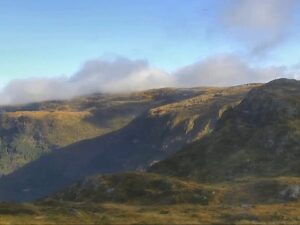
 5.2°C / 41.4°F



 6.8°C / 44.2°F