Live
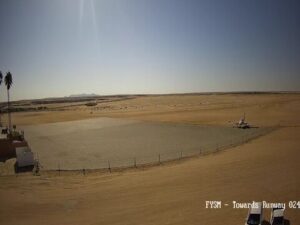
Swakopmund Airport (FYSM), Namibia
Swakopmund Municipal Aerodrome, Swakopmund, Namibia
 17°C / 62.6°F
 15:21
15:21 16:21:27
 28.3°C / 82.9°F
 Few Clouds
 27%
27% 13 km/h / 8 mph
 06:15
06:15 18:21
18:21Loading forecast…
Swakopmund Municipal Aerodrome, Swakopmund, Namibia
17°C / 62.6°F
15:21
Stony Point Nature Reserve, Wallers Road, Betty's Bay, South Africa
 16.3°C / 61.3°F
15:21
16.3°C / 61.3°F
15:21

Kruger Shalati - The Train on the Bridge, Kruger National Park, Skukuza, South Africa
34.2°C / 93.6°F
15:21




Paarl Golf Club, Wemmershoek Road, Boschenmeer Golf Estate, Paarl, South Africa
21.7°C / 71.1°F
15:21
Tembe Elephant Park, KwaZulu-Natal, South Africa
36.1°C / 97°F
15:21

The Ol Pejeta Webcam looks out over a waterhole at Porini Rhino Camp, on the quiet western side of the Ol Pejeta Conservancy in Laikipia County, Kenya. The frame is mostly open ground: churned red earth around the water, a low line of scrub and acacia along the horizon, and a wide equatorial sky that stacks up cloud through the afternoon. Animals set the pace here. A herd can fill the foreground for twenty minutes and then leave the scene empty for an hour, which is closer to how a waterhole behaves than any edited wildlife film suggests. Elephant, zebra, giraffe and warthog are among the regulars, and the country behind the camera is some of the most closely guarded rhino habitat in Africa.
Ol Pejeta covers 360 square kilometers (140 square miles) of Laikipia County in central Kenya, west of the town of Nanyuki and sitting directly on the equator. The conservancy occupies the gap between two of the country’s highland massifs, with the Aberdare range rising to the southwest and Mount Kenya to the east. The land worked as a cattle ranch long before it held tourists. A game reserve opened here in 1988, and in 2004 a conservation organisation bought the property outright to run it as a not for profit.
Rhino are the reason most people know the name. This is the largest black rhinoceros sanctuary in East Africa, and the IUCN classes the population here as “Key 1”, meaning it matters to the survival of the eastern black rhino as a whole. The herd passed one hundred animals in 2013. The conservancy is also the last address of the northern white rhino anywhere on earth: four were flown in from a Czech zoo on 20 December 2009, named Sudan, Suni, Fatu and Najin. Suni died on 17 October 2014 and Sudan was euthanized on 19 March 2018, which leaves the two females, Najin and Fatu.
The camera itself sits at Porini Rhino Camp, a small tented camp in a secluded valley on the western side of the property, set beside a seasonal stream and shaded by acacia. A salt lick near the water explains some of the steady traffic in frame, drawing giraffe, impala, warthog and zebra in particular.
Highland altitude on the equator makes this a cooler place than the latitude implies, and one that varies little across the year. At Nanyuki, the nearest town of any size, average highs run from 22 C (72 F) in July to 26 C (79 F) in February, working out to about 24 C (75 F) across the year. Nights are genuinely cold by tropical standards, with average lows near 7 C (45 F) in January and reaching only about 11 C (52 F) in April, for an annual mean around 9 C (48 F). On the Ol Pejeta Webcam this reads as hard overhead sun through the middle of the day, long raking shadows early and late, and light that disappears fast at dusk, since the equator gives almost no twilight.
Rain marks the seasons more clearly than temperature does. Nanyuki takes roughly 700 millimeters (27.5 inches) a year in a weakly trimodal pattern, rather than the two clean wet seasons much of Kenya works to, and January and February stand out as a distinct dry spell. April is the wettest month at around 120 millimeters (4.7 inches), with a second peak in November near 86 millimeters (3.4 inches). Wet months green up the scrub along the horizon and tend to scatter animals across the conservancy, because standing water sits almost everywhere. Dry months reverse that, and a waterhole camera typically sees its heaviest traffic once the surrounding country has dried out.
Several stops on the conservancy come with the entry fee and need no separate game drive booking. The Morani Information Centre covers the species living on the property and the daily work of protecting them, and it is where Baraka lives: a black rhino who lost his sight to injuries sustained when he was young, and who now occupies a protected enclosure where a ranger can walk visitors in to feed and touch him. The Ol Pejeta Nature Trail is included too, as is Sweetwaters Chimpanzee Sanctuary, which opened in 1993 and holds 43 chimpanzees. It remains the only place in Kenya where chimpanzees can be seen, and one resident, Poco, is known for standing and moving upright.
Seeing Najin and Fatu takes a separate arrangement, as the pair live under guard in the conservancy’s Endangered Species Enclosure and are visited on a booked guided tour. Outside the gates, Nanyuki is the practical base for this part of Laikipia. The town sits just north of the equator at 0 degrees 1 minute north, northwest of Mount Kenya, and it is the usual staging point for climbs and treks on the mountain.
These cameras cover comparable ground elsewhere in Kenya and across southern Africa.
Ol Pejeta lies in Laikipia County in central Kenya, immediately west of the town of Nanyuki and straddling the equator. It occupies the ground between the Aberdare range to the southwest and Mount Kenya to the east.
The camera covers a waterhole and salt lick at Porini Rhino Camp, with open red earth in the foreground and a line of scrub and acacia on the horizon. Giraffe, impala, warthog and zebra are drawn to the salt lick, while elephant, lion and both black and white rhino range across the wider conservancy. Nothing is guaranteed at any given moment.
Cool and stable for the tropics. Average highs at nearby Nanyuki sit between 22 C (72 F) and 26 C (79 F) year round, with nights dropping to around 7 to 11 C (45 to 52 F). Annual rainfall is about 700 millimeters (27.5 inches), peaking in April and again in November, with January and February the driest stretch.
Yes. Najin and Fatu, the only two left anywhere, live here under permanent guard in the Endangered Species Enclosure. They arrived from a Czech zoo in December 2009 in a group of four, alongside Sudan and Suni, both of which have since died.
Sweetwaters Chimpanzee Sanctuary on the conservancy is the only place in Kenya where chimpanzees can be seen. It was established in 1993 and cares for 43 chimpanzees, split into two groups on either side of the Ewaso Nyiro River.
Kenya runs three hours ahead of UTC, and the equatorial day stays close to twelve hours long all year. Early morning and late afternoon give the softest light and longest shadows, while midday is bright and flat. Darkness falls quickly after sunset, with very little dusk in between.
Source: Africam
The best new live webcams and site features, once a week.
By subscribing you agree to receive our weekly email. Unsubscribe any time.
 36.2°C / 97.2°F