
Live
Hog's Breath, Duval Street, Key West, Florida
Hog's Breath Saloon, Front Street, Key West, FL, USA
 27.9°C / 82.2°F
 18:29
18:29 18:29:21
 25.3°C / 77.5°F
 Broken Clouds
 71%
71% 28 km/h / 17 mph
 07:24
07:24 18:44
18:44Loading forecast…
Hog's Breath Saloon, Front Street, Key West, FL, USA
27.9°C / 82.2°F
18:29


St George St, St. Augustine, FL, USA
 20.9°C / 69.6°F
18:29
20.9°C / 69.6°F
18:29
Save the Manatee Club, Wekiva Springs Road, Longwood, FL, USA
21.8°C / 71.2°F
18:29
Fort Myers Beach, Estero Island, Florida, USA
 27.5°C / 81.5°F
18:29
27.5°C / 81.5°F
18:29


Las Olas Beach, Las Olas Circle, Fort Lauderdale, FL, USA
25.9°C / 78.6°F
18:29
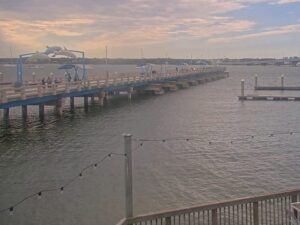

Siesta Key, Midnight Pass Road, Sarasota, Florida, USA
27°C / 80.6°F
18:29The Miami Skyline Webcam looks south over downtown Miami from high above the mainland end of the MacArthur Causeway, with Biscayne Bay filling the left of the frame. Downtown’s towers stand across the middle, the Kaseya Center arena sits at the water’s edge, and the white arches of the new I-395 Signature Bridge climb out of a construction site on the right. Below the camera, traffic loops along the I-395 ramps that carry cars onto the causeway and over the water to Miami Beach. Morning sun comes up over the bay on the left, tall clouds often build over the water on wet-season afternoons, and the cranes on several rooftops mean the outline of the skyline keeps changing from one month to the next.
The camera is part of the Ozolio network and streams on the Ozolio Live YouTube channel, which lists it as a MacArthur Causeway cam. Its framing is much wider than the road. On the far left, a low bridge crosses the bay toward PortMiami and the Bayside observation wheel turns at the waterline. The curved white roof in the middle belongs to the Kaseya Center, home of the Miami Heat.
Closer to the lens is Maurice A. Ferre Park, the waterfront green known in earlier years as Bicentennial Park and then Museum Park. Two museums share it. The Perez Art Museum Miami, designed by the Swiss firm Herzog and de Meuron, opened in December 2013 under a deep canopy hung with vertical gardens by the French botanist Patrick Blanc, around 80 kinds of plants picked to survive subtropical heat and hurricanes. Next door, the white sphere of the Phillip and Patricia Frost Museum of Science, a $275 million building that opened in May 2017, is one of the easiest landmarks to pick out on screen.
The highway curving through the foreground is I-395, which has fed straight onto the causeway since the 1970s. The MacArthur Causeway opened on February 17, 1920 as the County Causeway and was renamed in 1942 for General Douglas MacArthur. It runs 5.6 kilometers (3.5 miles) across Biscayne Bay to South Beach, carrying six lanes of State Road A1A past Watson Island and the residential islands of Palm, Hibiscus and Star. The large building at the lower right is the Adrienne Arsht Center for the Performing Arts, which opened as the Carnival Center on October 5, 2006, with the Signature Bridge arches rising behind it.
Miami has a tropical monsoon climate, with hot, humid summers and short, warm winters. In January, the coolest month, average highs reach 24.6 C (76 F) and lows fall to about 16 C (61 F). The drier months from November to April often give the clearest views of the towers and the bay. July and August average highs of 32.6 C (91 F) and lows of about 25.3 C (78 F). The wet season officially runs from May 15 to October 15, and the city collects an average of 1,710 millimeters (67.4 inches) of rain a year, often in short, heavy downpours that can hide the skyline on screen before clearing again.
Hurricane season runs from June 1 to November 30, with the busiest stretch from mid-August to the end of September. When a storm passes, the camera can show rain bands sweeping across the bay and whitecaps on the open water left of the park. Winter is the opposite story. Miami has never recorded accumulating snow, the only flurries on record fell on January 19, 1977, and the last freezing temperature at Miami International Airport was logged on December 25, 1989.
Almost everything in the frame can be reached on foot. The Perez Art Museum Miami and Frost Science sit side by side in Maurice A. Ferre Park, and the science museum’s sphere holds its planetarium. A short walk south along the bay, the Kaseya Center hosts Miami Heat games and large concerts, and Bayside Marketplace beyond it has the observation wheel and the docks where sightseeing boats leave for cruises past the waterfront homes on Star Island. North of I-395, the Adrienne Arsht Center stages opera, ballet and touring Broadway shows in the Ziff Ballet Opera House and the Knight Concert Hall.
The Metromover, the free automated train that loops through downtown, links most of these stops, with stations at Museum Park and at the Adrienne Arsht Center. To see the bay from the other direction, cross the MacArthur Causeway itself. Watson Island, the first island along the route, is home to the Jungle Island animal park, and the causeway lands at South Beach, a few blocks from the Art Deco Historic District and South Pointe Park.
For more of South Florida and another Florida skyline, these cams are a good next stop.
It is in downtown Miami, Florida, on the mainland side of Biscayne Bay near the point where I-395 meets the MacArthur Causeway. The camera faces south over Maurice A. Ferre Park and the downtown towers, with South Beach 5.6 kilometers (3.5 miles) away at the far end of the causeway.
Biscayne Bay on the left, the downtown skyline across the middle, the Kaseya Center and the Bayside observation wheel at the waterline, the Perez Art Museum and the Frost Science sphere in the park, I-395 traffic in the foreground and the arches of the Signature Bridge on the right.
Partly. The operator names it as a MacArthur Causeway camera, but it points south over downtown rather than east along the causeway. The start of the causeway shows at the lower left, where the road leaves the mainland over the water, and the I-395 ramps that feed it curve through the foreground.
They are the I-395 Signature Bridge, an $840 million Florida Department of Transportation project that rebuilds the highway through downtown. Work began in 2016 and is still going. The design uses six arches, the tallest more than 90 meters (300 feet) high.
That is the Kaseya Center, home of the Miami Heat. It opened on December 31, 1999 as the American Airlines Arena and cost $213 million to build.
Warm all year. Average highs run from 24.6 C (76 F) in January to 32.6 C (91 F) in July and August, and the wet season lasts from May 15 to October 15.
From June 1 to November 30, with the most activity between mid-August and the end of September.
The drier months from November to April are the most comfortable, with January highs around 24.6 C (76 F), less rain than in summer and the whole stretch falling outside the peak of hurricane season.
Source: Ozolio Live
The best new live webcams and site features, once a week.
By subscribing you agree to receive our weekly email. Unsubscribe any time.